What Exactly Does the Word ‘Law’ Mean?
As part of a special concerning the “Freedom For Which the Flag Stands“, and just in time for the elections, I am featuring a special treat for my viewers. In the final of a Five part weekly series for 2024, I am featuring the scope of what the word “law” really means. What is the difference? Is what you think law is really a law–or not? Is is a state issue, or is it Federal? Is it criminal law, civil law, an ordinance, or a by-law? Can I call the police? Can the police even help me? Do I file a case in the courts of law?

Photo by Michael on Unsplash
Is It Federal Law or State Law?
It is still important to note that states control most of the laws on the books, so it is important to note that voting for your state officials is very important. Each state has different laws, and different structures–all of which are designed around the U.S. Constitution. When the laws being violated end up violating the particular state’s constitution, the laws in question go through that state’s appellate courts, then if not settled amicably, they go to that particular state’s supreme courts. When state law violates the U.S. Constitution, the venue is moved into the Federal Court system’s Judicial Branch, going to a branch court first, then an appellate court, then the U.S. Supreme Court. The distinguishing factor is that the law being violated MUST violate a Federal law, or, violate a citizen’s federal rights as guaranteed in the U.S. Constitution before the case has authority to move venue into the Federal system.
Federal Law:
Federal law is tricky. This is because if it is a Federal law, it is law that is passed by a certain Legislature number, meaning the session that was in order when the law is passed by our Congress, meaning it passing through the Legislative Branch or Congress, meaning both the House of Representatives and Senate, then thereby going on the be signed into law by the President of the United States of America.

FED – United States Homeland Security Office of Investigations Special Response Team Image courtesy of Openverse
Now you see the problem and why I believe the decision that our Federal government has dissected, and even more, are on their way in many various forms of violating the U.S. Constitution whereby individual departments of the Federal branch, having overstepped their bounds of authority, have had issues of unlawful authority. These were first issued in time of COVID-19 and then in other recent issues like ‘climate change’ and others, where departments issued disaster proclamations. The problem with this is exactly this: with the administering any executive order specifically needs to be a law before it can be litigated. Therefore any and all administration orders were never considered ‘law’. Therefore the actions cannot be backed up by the court system. Also, case by case the chances of winning damages including punitive damages from the ‘administrators’ are high, if they were not elected officials, or if elected officials are acting out of their position within their elected positions. This is the reason why people in the administration are so “mad” about recent decisions from within the Supreme Court. The decision to implement executive orders as ’emergencies,’ and not have Congress pass laws to produce litigation to back up them as being law is going to cause a mass attack of lawsuits and also class action lawsuits. This is going to cost billions if not trillions of dollars personally from the people who thought that they could use the United States government as a government style other that that of the republic as guaranteed in the U.S. Constitution. Be looking for this litigation in the next months to years, but don’t count on it being in the news much, due to a stance of colluding and covering up of #RealNews being presented present days. Remember, any and everything not passed in a legislature is open to certain litigation naming original defendants as plaintiffs in civil litigation. The legislatures had ample time to pass litigation backing up the COVID-19 emergencies, and a lot of legislatures did not exercise their positions as legislators, annulling actions taken as invalid actions.
Similar style problems have happened within states as well, but do not become a Federal violation until it encroaches violating one’s rights as guaranteed by the U.S. Constitution. If they do not become Federal, the cases stay within the state, to be tired in the appropriate states supreme court system. The technicality of a states interpretation of such laws can become Federal really quick, as all states are required to pass laws similarly though a state congress and a passing by a state governor. If this process is not followed, and tried in a state supreme court , then if a U.S. Constitution interpretation is found to make the case a Federal case, the U.S. Constitution can decide to take a case: case-by-case.
Federal Law Provision:
|
FEDERAL LAWS AND REGULATIONS
|
| Federal laws and legal issues on website: usa.gov |
Other Common Federal Department Laws:
- Social Security Law: Social Security law is implemented to protect those who are who collect Social Security, SSDI, or any other form of offering from the Social Security Administration. The laws are ever changing, and you must keep up with the changes. The easiest way to do this these days is to go online at www.ssa.gov.
- Medicare Law: Medicare law is implemented to protect those who are on Medicare. The laws are ever changing, and you must keep up with the changes. The easiest way to do this these days is to go online at www.medicare.gov.
- Medicare Part C Law: If you have a Part C Medicare policy, also known as Medicare Advantage,you are enrolled in a third party in lieu of having traditional Medicare (Part A, Part B & Part D). The third party must comply with the laws of Medicare, but you have to deal with any issues with the company, with the oversight of a “Federal Services” company, who reviews you appeal directly so that you get the service and care that you deserve for health insurance through Medicare.
- Appeals Process for Medicare: The appeals process goes through a series of Medicare courts. You often will have a hearing from a hearing officer and judge through the phone system, whereby a judge rules via the telephone. This is present whether you have tradition Medicare or Medicare Advantage.
- More. . .
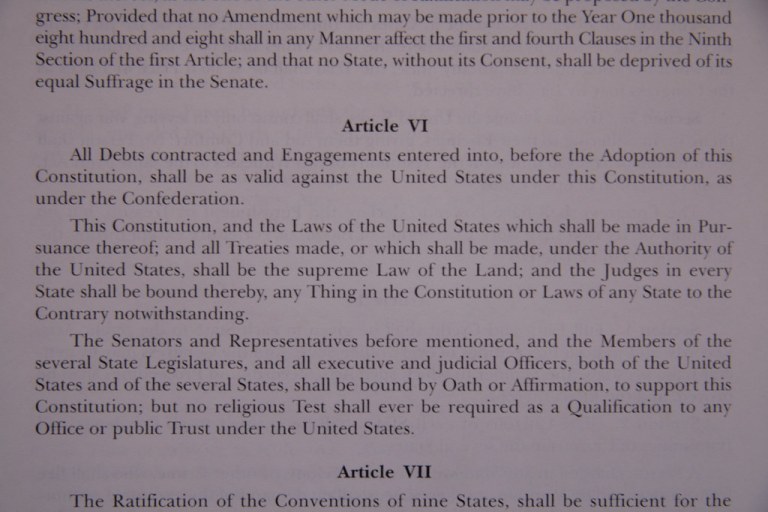
Article VI of the United States Constitution courtesy of Openverse
States’ Law:
Laws are designed to protect everyone’s right to freedom. With any type of freedom comes responsibility. In order to protect citizens and their rights, laws are enacted for the protection of the common good. Imagine having the roads with no laws. People would die with no traffic control. This same type of control is instilled with the passage of law, so that all citizens can live harmoniously together to enjoy the freedoms we all so greatly enjoy.
Laws are passed through the term called litigation. Whether your state is considered a state or commonwealth, litigation is present as dispelled in the U.S. Constitution that all states possess their own constitutions. which these constitutions are drawn up and passed upon each state’s ratification process. All states are required to pass laws similarly though a state congress and a passing by a state governor. Laws once passed are considered similarly as the state’s “compiled statutes”. These statutes are the guideline to common law. The offenses for offending any of the statutes are determinable considered as two types of criminal activity. More major crimes as “felonies,” and lesser crimes known as “misdemeanors.” Felonies invoke prison sentences and fines, while “misdemeanors” invoke jail time and/or fines.
When control is too greatly imposed, a lawsuit can be enacted whereby the passed law is challenged in the court of law that the laws intent or intensity has infringed upon any or all citizen’s rights as a state’s citizen. This is why there have been record lawsuits filed since the COVID-19 era. Officials were abusing their authority. With the new ruling with the U.S. Supreme Court determining that officials have immunity within the scope of their being an official, it will be tried time and time, again to see that even though they look like they are representing the government, when they were acting “for personal reasons.” In the months and years ahead, it is not going to be the good days of the corrupt official.
Statutory Law Pages’ Websites:
|
EACH U.S. STATE’S STATUTES ON THE WEBSITE
|
| Alabama |

Photo by Conny Schneider on Unsplash
Civil Law vs. Criminal Law:
Can I call the police for a criminal issue?
Criminal Law: In order for police to become involved with settling an incident laws governed under the statutes must have been violated. The police look for a compiled statutes violation in order to have the incidence elevated into a case where the county’s district attorney. The district attorney weighs how the case will be brought before a grand jury, so that the case can be heard in the local court of law, be it a county, district court or a municipal court depending on the local hearing laws. The defendant can be moved into a county jail and inducted to be a defendant after being booked, fingerprinted and mug-shots being taken. Typically, a pre-trial hearing is heard where a judge will determine whether an interpreter is necessary, and conditions including bond/bail is set, or whether a recognizance bond issued, or other conditions to have a release of a defendant, and an initial court date is set. Also a financial affidavit form is offered when the question of whether or not a defendant will be able to afford an attorney at law, and if not–a public defender is assigned to the case at no charge to the defendant.
Speedy Trial: The U.S. Constitution guarantees the defendant (not the state) a speedy and fair trial. The amount of time between a bonding date and trial must be in a speedy fashion, as described in the constitution of that state, and also within the rules of the U.S. Constitution. Any delays (scheduling conflicts, defendant delays, indictment dismissal or mistrial/new trial), and the time stops by what is termed “tolling”. The anticipated time frame for a speedy trial for individuals in pretrial detention should be established at ninety days from the date of the defendant’s initial court appearance following the submission of a charging document. For those on pretrial release, the expected limit should extend to 180 days from the date of the defendant’s first court appearance, which may occur after the filing of any charging document or the issuance of a citation or summons. Additionally, shorter presumptive time limits for speedy trials should be implemented for individuals charged with minor offenses. If a case has to be discharged due to lack of a speedy trial, it can become very dangerous to let the wrong defendant go free, and the results can be disastrous.
Request For Plea: The initial court date has all the details disclosed upon the court officials: the judge, the court reporters, and either a continuance will be issued (most states will issue at least one continuance for most offenses), or the judge will ask for a pleading: guilty, not guilty or no contest.
Plea of Guilty: If a guilty plea is revealed, it is always an admission of guilt, and when does either a sentence hearing can be set, or a plea bargain can be offered. Plea bargaining depending on the sentencing usually, but not always is supervised in the judge’s’ chambers. A guilty plea with a plea bargaining sometimes in the case of a traffic or DUI case will go on that driving record as if the case had not been plea bargained: the court cannot bargain with a states secretary of state’s different ruling whereas the offense being on a driving record.
Plea of No Contest: A no contest plea is an alternative to entering a plea of guilty or not guilty, succumbing to all the fines and/or imprisonment, but the defendant neither acknowledges nor contests the charges against them. This is most useful when a case where the defendant does not admit to wrongdoing but agree to face the consequences as if they had pleaded guilty. This plea is frequently utilized in the context of plea negotiations..

Photo by Library of Congress on Unsplash
Plea of Not Guilty: If the plea is not guilty, a new hearing date is set and a decision at that hearing as to whether or not the trial will by jury or bench trial will be heard. If a bench trial happens the judge will determine the outcome of the said trial hearing. The hearing happens either way as the facts are revealed in the court of law.
Trial by Bench Judge: If it is a bench trial, the defendant is at the mercy of the judge to make a determination. No one has to suffer having a trial by a bench judge, so if a jury trial is requested as per the guarantee of the U.S. Constitution that each person has a right to fair trial by a jury of their peers. So if a jury trial is requested, the jury hears the whole trial, and goes into a jury deliberation room.
Trial by Jury: In all 50 states, everyone has right of trial by fair trial by a jury of their peers. Prior to sequestering of a jury, the jury should be provided with a comprehensive set of guidelines. The guidelines need to be uniform and fair to both the states attorney and the defendant, not favoring a side. These guidelines must be articulated by the judge to the defendant, ensuring that they are impartial and do not favor either the district attorney or the defendant in any manner. The jury is required to present its verdict to the judge in a public court setting, and this verdict must be reached unanimously. If the bench judge or 12 jurors decide a verdict of not guilty on any and all of the charges, the defendant is acquitted completely of the charges rendered. A partial acquittal occurs when a defendant is deemed not guilty of certain charges while still facing others. This situation arises when a jury or judge determines that the evidence presented is insufficient to secure a conviction on all counts. A verdict of guilty on all counts can lead to a stiff sentence, if the judge and district attorneys are able to have sentences be served consecutively. Jury nullification takes place when a jury delivers a not guilty verdict despite the jurors’ firm belief, beyond a reasonable doubt, that the defendant has violated the law. Since the not guilty verdict is final and cannot be reversed, and jurors cannot face repercussions for their decision, the law is effectively rendered void in that specific instance.
Charges Served Concurrently: If a trial, and/or a jurisdiction wishes to bargain (whether or not a part of a plea bargain) to have sentences served concurrently with or without similar charges in the same state, possibly even in a different county to be served concurrently, it means that all the sentences are being served at the same time, overlapping that of the other sentences. So if you have 5 counts with a 364-day sentence each, and a year is served on concurrent sentences–after that whole 364-day sentence is served (less any time for good behavior), the inmate is released on the last day of the longest sentence in a group of concurrent sentences. The rules are similar with a few exceptions for felonies for a prisoner release.
Charges Served Consecutively: If a trial, and/or jurisdictions have aggravated circumstances to be punitive, they can elect to have sentences served consecutively. This means that if either the same county or multiple counties do not agree to a type of concurrent sentence, that each charge, say two 364-day sentences, that the sentences start when the last sentence is finished, thereby making the 2 x 364-day sentences be serving of 728 days of sentencing. This happens often time when two or more counties figure that the defendant has reasonable doubt that they may pose a threat to society, and believe it to be in the best interest of the public at large to serve up a consecutive sentence. Most likely if there are charges across state lines, if the Federal authorities do not get involve, or if the crimes are not connected in different states, the sentences are almost always served consecutively, so when one sentence is served, the defendant must remain remanded from one state’s jurisdiction to another jurisdiction.

Photo by Joshua Armstrong on Unsplash
Can I call the police for an ordinance violation?
Ordinance Violation: Police are almost always called for the public to report an ordinance violation, except also other local government officials, such as a building officer or other figure. In most states, violations of ordinances are classified as civil offenses rather than criminal offenses, and they are generally handled in local courts. These violations are charges brought forth by a municipal government for the infringement of local laws, regulations, or codes. The typical repercussions for an ordinance violation involve monetary fines, and such violations do not lead to incarceration or the establishment of a criminal record. Nevertheless, some observers argue that the proceedings related to ordinances can bear similarities to criminal cases, as the municipal plaintiff pursues the action in its official capacity, with the primary rights at stake being those of the public.
Can I call the police for a civil issue?
Civil Law: If there is not a criminal issue or an ordinance violation, most of time, a police officer will not be able to assist you with the issue. If you are in a disagreement that has not lead to unlawful activity, there will be nothing that the police will be able to offer you in order to remedy the situation. Despite the situation being a tort or civil violation, the police will not be able to offer any assistance, and police never give legal advice. CIvil law always starts with filing a case with the local courts clerk’s office, or if in a specialty court, with their clerk’s offices.
Criminal Losses: If there is a criminal issue whereby a defendant cannot be picked up or if a defendant cannot be identified, or for a civil issue, the police will not be able to turn to prosecution and remains an incident. The incidence can be used for other reasons such as insurance or a business loss. It is imperative to have the incidence report number for your files to capture the loss.
Nationwide Index on All States’ Court Cases (By State):
In order to find a state case through the courts of the states’ system as opposed to in the United States federal court system, you can contact each state from the federally provided court list to find out about your individual state at: State Court Web sites | NCSC.


schools of traffic courtesy of Openverse
Traffic Law:
Traffic law is a tricky area of law in that it affects essentially three areas of law, at the same time. Typically when a ticket is issued, first it goes to the court, whereby just like any crime, it is tried in a traffic court with a judge, and you are also even able to have it tried with a jury at your own expense (unless you are found not guilty, and you could sue back for fee reversal), if you deem it necessary. But, also as you are found guilty, the ticket is reported to the secretary of state and it goes on your traffic record. Sometimes traffic school and supervision are offered as a way to have a ticket “not” reported to the Secretary of State. If you violate the supervision terms or agreement in the traffic school–and another offense occurs in the time period you agree not to get another ticker, the terms state that the offense will indeed be reported to the secretary of state, and also no recourse, i.e.-refunds on fines instituted to incur supervision will be implemented, and total loss and reporting be deemed. Also, the third liability of incurring a ticket is when your insurance company submits a request for your driving record, and a ticket shows up of the driving abstract. Traffic law go into being a crime (misdemeanor/felony) when major violations occur, such as:
- Passing a school bus with the STOP sign extended
- Crossing over a railroad crossing with the light activated and/or the gates down
- Reckless driving
- Eluding an officer attempting to pull you over, invoking a chase
- Drug/alcohol related offenses
- DUI
- Driving while license is suspended/revoked
- Injury/Killing another in an accident

Photo by Iñaki del Olmo on Unsplash
Corporate Law:
Corporate law is legal laws that assist in making the business world transpire. Even though the laws are not a crime, they are often a definite civil matter, that even though they are often not on a government’s books, they will be construed to have a court uphold the proper law as agreed upon by the holders of the bylaws. These issues are some of the laws that are typical in the corporate world of law:
- Acquisitions: Mergers and acquisitions (M&A) often encompass legal procedures, including non-disclosure agreements (NDAs) and letters of intent (LOIs). The duration of the M&A process can extend over several months, and acquisitions may be contingent upon certain conditions precedent (CPs) that need to be fulfilled prior to finalizing the acquisition. These CPs may involve obtaining consent from third parties, approval from shareholders, or clearance for the merger.
- Contract Law: A contract is a legally binding agreement between parties to create mutual obligations that businesses and individuals use to protect their interests. Contracts outline the specific terms of engagement for a transaction. They can also dictate legal consequences if a party tries to break the agreement. In order for a contract to be valid, the contract must have consideration, whether it is monetary or other form of exchange of assets, between both of the involved parties.
- Corporate Governance: Corporate governance law encompasses a framework of regulations, practices, and procedures that oversee and direct a company’s activities. It is fundamental to the structure of a corporation and addresses various aspects, including:
- Decision-Making: The processes by which directors and officers address significant matters
- Relationships: The interactions among management, the board of directors, shareholders, and other stakeholders
- Performance: The methods employed to assess a company’s performance and attain its objectives
- Labor Law: Employment law, often referred to as labor law, is a legal domain that regulates the interactions between employers and employees, safeguarding the interests of both parties. It delineates the rights of employees and the obligations of employers. The issues that arise are filed with a labor board, not the police. Some issues with labor law include:
- Workplace Safety: Mandating that the work environment is secure and devoid of unnecessary risks.
- Fair Compensation: Ensuring that employees receive equitable wages and are compensated for overtime when applicable.
- Fair Treatment: Shielding employees from discrimination, harassment, and unjust treatment.
- Reasonable Accommodations: Obliging employers to offer reasonable adjustments for employees’ medical conditions or religious beliefs when legally required.
- Unfair treatment: Shielding employees from discrimination, harassment, and other forms of unjust treatment
- Work hours: Governing the permissible working hours for employees
- Family and medical leave: Addressing the requirements for family and medical leave
- Hiring process: Promoting a fair and just hiring procedure
- Trade unions: Defining the function of trade unions
- Additional Regulations: Other issues including the recruitment process.

Photo by Gabrielle Henderson courtesy of Openverse
- Intellectual Property: Intellectual property law safeguards the products of human intellect, including inventions, designs, and artistic expressions, enabling their creators to achieve financial rewards or receive acknowledgment. Additionally, IP law seeks to harmonize the interests of creators with those of the public by fostering an environment conducive to creativity and innovation.
- Venture Capital: Venture capital law encompasses a wide range of legal frameworks that govern and promote the investment of capital into emerging businesses. This field addresses various legal considerations, including:
- Financing & Mergers/Acquisitions Transactions: Encompassing mergers, acquisitions, strategic partnerships, and alternative financing arrangements.
- Corporate Governance: Addressing employment-related issues and compensation structures. Intellectual property rights: Focusing on protection, enforcement, and monetization strategies.
- Tax Considerations: Including adherence to securities regulations.
- Corporate Law:Corporate law pertains to the legal framework governing various aspects associated with the life-cycle of a corporation. It encompasses regulations that affect corporations, investors, shareholders, directors, employees, creditors, and other stakeholders, including consumers and the community. This area of law addresses the formation, financing, governance, and dissolution of corporations, ensuring that all parties involved are appropriately regulated.
- Security: Securities law governs the issuance, trading, and offering of securities, which represent investments in various enterprises. These securities may encompass stocks, bonds, loans, mortgages, and other financial instruments. The primary objective of securities legislation is to guarantee that investors are provided with precise and essential information regarding the securities they are contemplating for purchase.
- Dispute resolution: Dispute resolution law, commonly referred to as alternative dispute resolution, encompasses methods for resolving conflicts between parties. This approach can be applied to a variety of disputes, such as those related to family matters, business transactions, housing issues, and consumer rights.
- Arbitration: Arbitration serves as a private mechanism for settling disputes without resorting to the court system. In this process, the involved parties consent to appoint a neutral third party, known as an arbitrator, who will render a binding decision. This method is frequently more cost-effective and less intricate than traditional litigation due to its more flexible procedural standards. Typically, arbitrators are former judges or legal practitioners who evaluate the arguments from both parties before delivering a ruling. Under the Federal Arbitration Act (FAA), enacted in 1926, arbitration decisions are deemed “valid, irrevocable, and enforceable.” Once arbitration concludes, the parties are precluded from pursuing the matter in court.
- Limited Liability: Limited liability is a legal concept designed to safeguard business owners and investors from personal responsibility for the debts incurred by a business. This principle confines the potential financial loss to the capital contributed to the business, thereby protecting the personal assets of the owners and investors. Typically, a shareholder’s liability is determined by the size of their investment in the enterprise.
- Property Law: Property law governs ownership of both tangible and intangible objects. Tangible objects include property such as personal belongings, vehicles, buildings, and land. Intangible objects include investments, bank accounts, copyrights, and trademarks.
- Competition Law: Competition law, also known as antitrust law, protects competition in a free market economy. The goal of competition law is to promote fair and open competition between industries and geographic markets, and to contribute to economic growth and sustainable welfare. Competition laws prohibit anticompetitive conduct and mergers that can deprive consumers, taxpayers, and workers of the benefits of competition.
- Corporate Finance: Corporate finance law is a complex area of law that governs the financial activities of businesses, including how they raise capital, make investments, and manage risk. It also ensures compliance with regulations, protects investors, and helps capital markets function smoothly.
- Nonprofit Organization: Nonprofit organizations are governed by various laws and regulations that differ at both the state and federal levels. The following are some key legal considerations for nonprofits:
- Taxation: Nonprofits are exempt from federal taxation provided they are established and operated for purposes that are charitable, scientific, educational, or otherwise recognized as tax-exempt. While these organizations may engage in activities that generate revenue, any profits must be reinvested into the organization to further its tax-exempt objectives.
- Distributions: Nonprofits are prohibited from distributing profits to individuals associated with the organization, including founders, directors, officers, key employees, or members.
- Corporate Formalities: Nonprofit corporations are required to adhere to specific corporate formalities, such as those outlined in the General Not For Profit Corporation Act of 1986 in Illinois. This legislation addresses various aspects, including the quorum requirements for directors, the formation of corporations, and the rules regarding distributions.
- Personal Liability Protection: Nonprofit corporations can offer a degree of personal liability protection to their directors, officers, and members; however, compliance with state and federal regulations is essential to uphold these protections. For instance, in Illinois, the intentional misuse of charitable assets or violations of fiduciary duty may expose individuals to punitive damages.
- Incorporations: Incorporation refers to the procedure of establishing a new corporation, which may take the form of a business, nonprofit organization, sports club, or local government entity. Upon incorporation, a business is transformed into a distinct legal entity, separate from its founders, and is acknowledged by the state in which it is incorporated. This newly formed entity, commonly known as a corporation or limited liability company (LLC), tends to possess greater credibility among customers, suppliers, and employees.
- Tax Law: Tax law, also known as revenue law, encompasses the field of legal study focused on the regulations and procedures employed by authorized entities, including federal, state, and municipal governments, particularly in the United States, to evaluate and gather taxes within a legal framework.
- Investor Ownership: Investment ownership pertains to the concept that investors possess assets and derive advantages from them. These assets may be tangible, such as real estate, precious metals, or infrastructure developments, or intangible, including corporate shares or bonds. Investors have the ability to trade financial assets via regulated markets or through private dealings.

Studio F P&S Condo Plans by Phil Manker Image courtesy of Openverse
- Homeowners’ Associations (HOA) Law: Hoa’s possess specific legal authorities and constraints, operating under either the certain state’s Condominium Property Act or a state’s Common Interest Community Association Act. Here are some of the scope of an HOA:
- Authorities: HOA’s are empowered to manage common areas, collect maintenance fees, enforce covenants and restrictions, and initiate eviction proceedings against homeowners or tenants who fail to pay dues or other fees. Additionally, they have the authority to impose fines, file liens against properties, and pursue legal action for non-compliance.
- Constraints: HOA’s are prohibited from banning the display of the American flag or imposing restrictions on certain religious practices. Furthermore, they are required to function within the parameters established by their governing documents and state law.
- Meetings: HOA’s are obligated to provide a minimum of a certain amount of days (10 days in Illinois) notice for association meetings, with a maximum notice period of 30 days. Meetings of the board of directors necessitate at least 48 hours’ notice. A quorum is established when 20% of the voting power is present.
- Bylaws Law: Corporation’s charter and bylaws are regulations established by organizations or communities that govern their internal affairs. These regulations may encompass various provisions tailored to the specific nature of the organization, including:
- Board composition: The stipulated minimum and maximum number of board members required at any time.
- Name and purpose: The official identification of the organization and the mechanisms to ensure compliance with its regulations.
- Stock: The decision regarding the issuance of physical stock certificates to shareholders. The documents traditionally give shareholders rights like:
- Inspecting the company’s books and records
- Voting on key corporate matters
- Receiving dividends if the board decides to pay them
- Attending annual meetings
- Suing the corporation for the actions of its directors and officers
- Membership provisions: The criteria for membership along with the associated rights and responsibilities of members.
- Standing rules: The schedule and location of meetings, as well as the detailed responsibilities of officers.
- Electing officers and directors: The procedures for the election of officers and directors, including the processes for confirming, amending, or rejecting the bylaws.
Unemployment Law:
Unemployment law is a combination of federal and state statutes that determine eligibility, benefits, and the length of time benefits are paid to unemployed workers. The federal Social Security Act established the unemployment compensation program in 1935, but each state administers its own program within those guidelines. The goal of unemployment insurance is to provide temporary financial assistance to eligible workers while they look for new employment. The implementation of benefits for unemployment are govern=ed by each state’s employment security department, state-by-state.

Romney Ryan Plan for Medicare and SSI courtesy of Openverse
Medicaid Law:
Medicaid is a medical assistance initiative that is co-funded by both state and federal governments, aimed at supporting individuals with low income. Established in 1965 as an amendment to the Social Security Act of 1935, Medicaid has evolved into a significant social welfare program, overseen by the Centers for Medicare and Medicaid Services.
The range of services covered by Medicaid includes inpatient hospital care, outpatient hospital services, laboratory and radiology services, skilled nursing facility care, physician services, physical therapy, hospice care, and rehabilitative services. Patients face limitations in choosing their healthcare providers, as they must select from a list of approved physicians and medical care providers. Due to insufficient reimbursement for services rendered to Medicaid patients, many physicians opt to limit the number of such patients they accept.
Federal regulations stipulate that states are prohibited from reducing other welfare benefits for individuals who qualify for Medicaid. Since its establishment, the program has encountered issues with fraud perpetrated by both healthcare providers and patients. In response to these challenges, Congress enacted legislation in 1996 that holds individuals criminally accountable for committing fraud to gain eligibility for medical assistance.
Supplemental Nutrition Assistance Program (SNAP) Law:
Food stamps, originally established in the Federal Food Stamp Act of 1964 and overhauled by the Supplemental Nutrition and Assistance Program (SNAP), is the most significant food plan in the United States. It provides food stamps for needy individuals that can be exchanged like money at authorized stores. Food stamps can only be used for food items and for plants and seeds used to grow food. Food stamps cannot be used to purchase nonfood items such as pet food, vitamins, and medicine. SNAP benefits are added monthly on an EBT card that can be refilled monthly. The amount of SNAP benefits depends on a variety of factors including income and dependents. The federal government pays for the amount of the benefit received, while states pay part of the costs of determining eligibility and distributing the benefits. In addition, state public assistance agencies run the program.

Food Stamps courtesy of Openverse
Even though the program is originated out of the U.S. Department of Agriculture’s SNAP Program, the program is governed as per each individual state with a department of human services in the particular state.
National Law Day on May 1st Every Year:
The American Bar Association receives credit for introducing the idea for Law Day in 1957. In 1958, President Dwight D. Eisenhower proclaimed Law Day to be observed each year on May 1. Congress later passed Joint Resolution 87-20 on April 7, 1961.
Conclusion:
The laws of the land are indeed a bureaucracy in themselves, but very needed to live in the times we do. Better, more civil living is always a good thing, when good tidings are the goal. This article is the last of the series Freedom For Which the Flag Stands Series: How Government Works ’24.

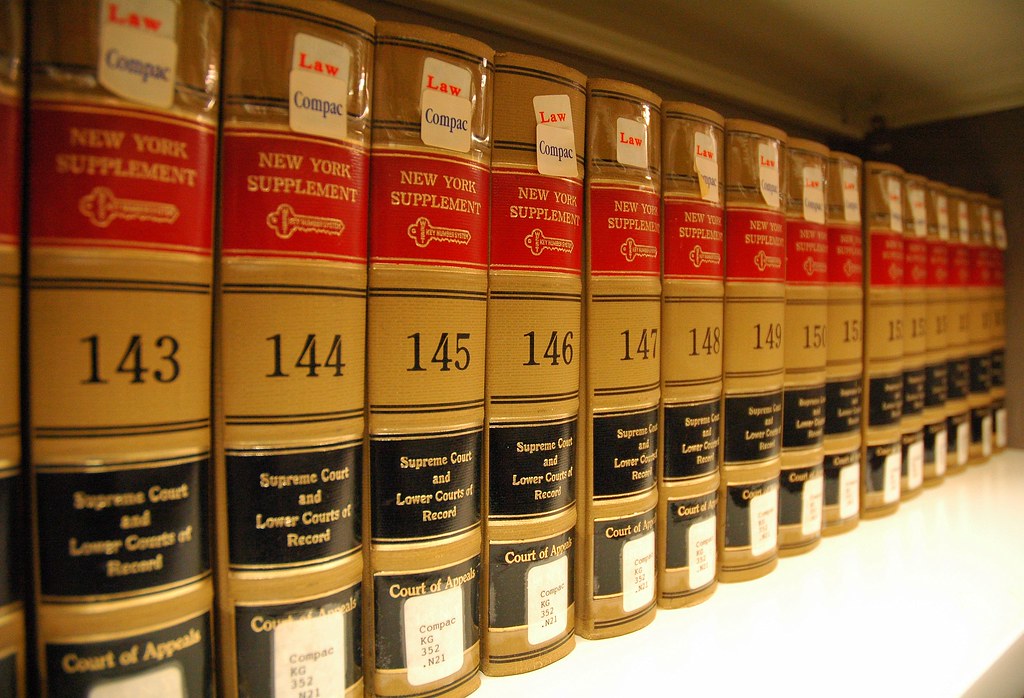
Law Books courtesy of Openverse
Please join the photo of the day starting This weekend. Look for the start of the “LEGO Government Monuments” Featured Photo of the Day special. Every week another great photo of a LEGO building or monument based on United States monuments.
PART 5: Freedom For Which the Flag Stands Series
This post has been added to the series that was originally posted in 2020, because people really need to know what law really is. This post completes the set of Versatileer “Freedom For Which the Flag Stands Series” posts.
Legislative Branch: How Government Works – PART I of Freedom For Which the Flag Stands Series ’24
Executive Branch: How Government Works – PART II of Freedom For Which the Flag Stands Series ’24
Judicial Branch: How Government Works – PART III of Freedom For Which the Flag Stands Series ’24
State Government: How Government Works – PART IV of Freedom For Which the Flag Stands Series ’24
More on Versatileer:
![20250808_15_00__two_epac_2d0__Ivo_.jpg]()
From the Satellite...Pacific Tropical Storm Ivo on .GIPHY & Video + 2025 Season Info
09/27/2025![Happy Numeric Lineage String Day_2-3-23.png]()
Happy Numeric Lineage String Day in 2023: 2-3-23 – Happening 3 Times Today!
02/03/2023![20231030_12_00__two_pac_2d0__Pilar.jpg]()
From the Satellite...Pacific Tropical Storm Pilar on .GIPHY & Video + 2023 Season Info
05/24/2024![wp-17024205600118584371416717245038.jpg]()
Featured Photo + Video: The 25 Days of Christmas – Day 12: Yuletide on Tripp Avenue, Oak Lawn
12/13/2023![The Full Buck Moon Turns to Partial Lunar Eclipse Happening Overnight]()
The Full Buck Moon Turns to Partial Lunar Eclipse Happening Overnight
07/04/2020
































This is some great information. Thanks for sharing.
Thank you for sharing