

Live Today on Versatileer all Day Christmas Eve:
THE SANTA TRACKER!
Brought to you courtesy of NORAD
 NORAD: “We have the watch.”
The North American Aerospace Defense Command (NORAD) is an organization jointly operated by the United States and Canada. Its primary objective is to safeguard the homeland by providing aerospace warning, aerospace control, and maritime warning for North America. Aerospace warning involves monitoring man-made objects in space and detecting, validating, and warning against potential attacks on North America, whether by aircraft, missiles, or space vehicles. This is achieved through collaborative efforts with other commands. Aerospace control ensures the air sovereignty and air defense of both Canada and the United States. In May 2006, the NORAD Agreement was renewed, expanding its mission to include maritime warning. This mission focuses on maintaining shared awareness and understanding of activities in U.S. and Canadian maritime approaches, maritime areas, and internal waterways. NORAD’s headquarters are located in Colorado Springs, Colorado. Over the years, NORAD’s mission has adapted to address evolving threats. Through exceptional bi-national cooperation, NORAD has proven its effectiveness in the areas of surveillance, warning, and response. The events of September 11, 2001 highlighted the ongoing importance of NORAD in ensuring North American security. Today, NORAD possesses a robust military response capability to counter domestic airspace threats, should all other measures fail. The dedicated personnel of NORAD remain vigilant, constantly monitoring the skies and waterways of the United States and Canada to ensure our safety.
NORAD tracks Santa and protects North America
Radar: The North Warning System, known as the NORAD radar system, serves as the starting point for this operation. With a total of 47 installations spanning across Canada’s North and Alaska, this robust radar system plays a crucial role. During the holiday season, NORAD diligently monitors the radar for any signs of Santa Claus departing from the North Pole. As soon as our radar detects Santa’s takeoff, NORAD promptly utilizes the same satellites employed for air warning against potential missile launches targeting North America.
Satellites: The satellites are positioned in a geosynchronous orbit, which implies that they remain stationary above a specific point on Earth. This orbit is situated at a distance of 22,300 miles from the Earth’s surface. Equipped with infrared sensors, these satellites possess the ability to detect heat. Whenever a rocket or missile is launched, an immense amount of heat is generated, making it easily visible to the satellites. Interestingly, Rudolph’s nose emits an infrared signature akin to that of a missile launch. Consequently, the satellites effortlessly detect the bright red glow of Rudolph’s nose.
Jet Fighters: The NORAD jet fighter is the final system utilized by NORAD. Canadian NORAD fighter pilots, operating the CF-18, depart from Newfoundland to greet Santa as he arrives in North America. Additionally, CF-18 fighter pilots from various locations in Canada accompany Santa. Meanwhile, American NORAD fighter pilots in F-15s, F-16s, or F-22s have the privilege of flying alongside Santa and his renowned reindeer – Dasher, Dancer, Prancer, Vixen, Comet, Cupid, Donner, Blitzen, and Rudolph. Despite Santa’s ability to fly faster than any jet fighter (he actually slows down for us to accompany him), the collective use of these systems enables NORAD to maintain a highly accurate and continuous understanding of his whereabouts.
Frequently Asked Questions (FAQs)
How long has NORAD been tracking Santa? NORAD commenced monitoring Santa’s whereabouts in 1955, succeeding its predecessor, the Continental Air Defense Command (CONAD). In 1958, NORAD assumed the responsibility of tracking Santa’s global journey, and they have diligently continued this annual tradition ever since.
Why does NORAD track Santa? NORAD diligently monitors aircraft, missiles, space launches, and all other airborne objects within or near the North American continent, around the clock, every day of the year. In addition to fulfilling various crucial missions, NORAD has inadvertently initiated the tradition of tracking Santa. With its advanced technology, qualified personnel, and unwavering dedication, NORAD remains the sole organization capable of this task. The team at NORAD takes immense pleasure in carrying out this responsibility and considers it a great honor to be Santa’s official tracker.
When will Santa arrive at my house? NORAD tracks Santa, but only Santa knows his route, which means NORAD cannot predict where and when he will arrive at your house. NORAD does, however, know from history that it appears he arrives only when children are asleep! In most countries, it seems Santa arrives between 9:00 p.m. and midnight on December 24th. If children are still awake when Santa arrives, he moves on to other houses. He returns later, but only when the children are asleep!
What route does Santa travel? Santa typically commences his journey at the International Date Line in the Pacific Ocean and proceeds in a westerly direction. Historically, he begins by visiting the South Pacific, followed by New Zealand and Australia. Subsequently, he makes his way to Japan, then traverses across Asia and Africa before reaching Western Europe. From there, Santa continues his route through Canada, the United States, Mexico, and Central and South America. It is important to note that Santa’s itinerary may be influenced by weather conditions, making it highly unpredictable. To ensure accuracy, NORAD collaborates with Santa’s Elf Launch Staff to confirm his launch time, but once he sets off, Santa takes charge while NORAD diligently tracks his progress.
Does Santa visit everyone? Indeed Santa believes in the children, so he visits all the homes where children believe in him.
How can Santa travel the world within 24 hours? According to intelligence reports from NORAD, it has been revealed that Santa’s perception of time differs from ours. While his journey appears to last 24 hours for us, it could potentially span days, weeks, or even months for Santa. Given the significance of his task in delivering presents to children and spreading joy to all, it is only logical to conclude that Santa operates within his own unique time-space continuum.
Is there a Santa Claus? Based on extensive historical data and NORAD tracking information, it is evident that Santa Claus continues to thrive in the hearts of individuals worldwide.
How old is Santa? According to NORAD intelligence, it is difficult to ascertain with certainty, but Santa is believed to be a minimum of 16 centuries old.
What does Santa look like? According to the flight profile data collected from NORAD’s radar and satellite tracking, it has been determined by NORAD that Santa’s height is estimated to be around 5 feet 7 inches, and he weighs approximately 260 pounds (excluding the weight gained from consuming cookies). By analyzing fighter-aircraft photos, it is evident that Santa possesses a substantial belly, rosy cheeks resulting from sleigh riding in chilly conditions, and a long white beard.
How does Santa get down chimneys? NORAD possesses various hypotheses and theories regarding Santa’s method of descending chimneys; however, the organization lacks conclusive information to elucidate this enchanting phenomenon.
Do NORAD’s planes ever intercept Santa? Throughout the previous 65 years, our fleet of fighter jets, including F-16s, F-15s, F-22s, and CF-18s, has intercepted Santa Claus on numerous occasions. Whenever our jets intercept Santa, they gracefully tilt their wings as a gesture of greeting, conveying the message, “Greetings Santa! NORAD is once again monitoring your journey this year!” Santa never fails to respond with a wave, as he thoroughly enjoys witnessing the pilots in action!
Does NORAD have any pictures of Santa taken from NORAD’s planes? Our fighter pilots have a great passion for capturing photographs of Santa Claus. NORAD introduces Santa Cams in space, which record videos of Santa as he travels across the globe. These captivating videos are broadcasted nearly every hour on December 24th, precisely at midnight on the International Date Line.
Does NORAD have any statistics on Santa’s sleigh? NORAD has verified that Santa’s sleigh is an adaptable, all-weather, multi-functional, vertically capable vehicle for short take-offs and landings. It possesses the ability to cover extensive distances without the need for refueling and is utilized, to the best of our knowledge, solely on the 24th of December (with occasional brief test flights occurring approximately a month prior to Christmas).
| Sleigh Technical Data | |
|---|---|
| Aspect | Information |
| Designer & Builder | K. Kringle & Elves, Inc. |
| Probable First Flight | Dec. 24, 343 A.D. |
| Home Base | North Pole |
| Length | 75 cc (candy canes) / 150 lp (lollipops) |
| Width | 40 cc / 80 lp |
| Height | 55 cc / 110 lp |
| Note: Length, width and height are without reindeer | |
| Weight at takeoff | 75,000 gd (gumdrops) |
| Passenger weight at takeoff | Santa Claus 260 pounds |
| Weight of gifts at takeoff | 60,000 tons |
| Weight at landing | 80,000 gd (ice & snow accumulation) |
| Passenger weight at landing | 1,260 pounds |
| Propulsion | Nine (9) rp (reindeer power) |
| Armament | Antlers (purely defensive) |
| Fuel | Hay, oats and carrots (for reindeer) |
| Emissions | Classified |
| Climbing speed | One “T” (Twinkle of an eye) |
| Max speed | Faster than starlight |
| Information is provided by NORAD. Alll right reserved via FANDOM. | |
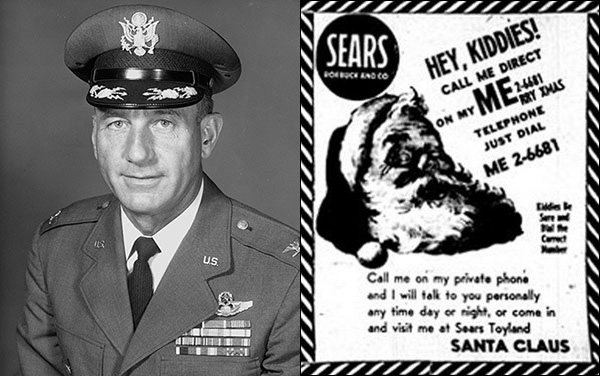
In Memory of Retired Colonel Harry Shoup, NORAD’s First Santa Tracker September 29, 1917 – March 14, 2009
The use of trade, firm, or corporation names on this website does not constitute an official endorsement or approval by the United States Department of Defense or NORAD of any product or service to the exclusion of others that may be suitable.
 Via Phone 1-877-HI-NORAD:
Join NORAD all year round:





NORAD Tracks Santa: All Day Today
LIVE CHRISTMAS EVE!
More on Versatileer:
![art-colorful-colors-colourful-261687 crayon_1680401171.jpeg Pixabay at Pexels]()
Happy National Crayon Day – 2023
04/01/2023![California_Ventura Freeway__Fujicolor 400.png]()
Photo of the Day: 11/07/19 – Off of Ventura Freeway, California
11/07/2019![eclipse-digital-wallpaper-580679 eclipse_1681912635.jpeg Drew Rae at Pexels]()
The Ningaloo Eclipse: Rare Hybrid Solar Eclipse to Happen Near Australia – Info On Future Solar Ecli...
04/19/2023![wp-17593295106461503161408011480660_.jpg]()
Featured Photo: The Beauty of Fall Color – Schubert's Woods Near Sauk Trail, Bloom Township #1
10/01/2025![Featured Photo: Architecture, Part 2 – Vintage Architecture – The Original Lake Shore National Bank]()
Featured Photo: Architecture, Part 2 – Vintage Architecture – The Original Lake Shore National Bank
04/30/2021