Happy Card Playing Day!
Yesterday was National Card Playing Day for 2025, serving as an invitation to gather with friends and engage in a few rounds of card games! What fun. . .
Happy Card Playing Day! ! !
♠️ ♦️ ♣️ ♥️ ♠️ ♦️ ♣️ ♥️ ♠️ ♦️ ♣️ ♥️ ♠️ ♦️ ♣️ ♥️
A Brief History:
Origination: In the 9th century, the Chinese initiated the creation of games that incorporated money and various paper items. The initial playing cards from this period were quite different from the more durable European playing cards that appeared several centuries afterward. Card games proliferated globally, taking on numerous forms and styles. From the intricate Mamluk designs found in Egypt to the introduction of the first playing cards in Early Renaissance Europe, these decks were categorized into four suits: coins, cups, swords, and sticks or batons.
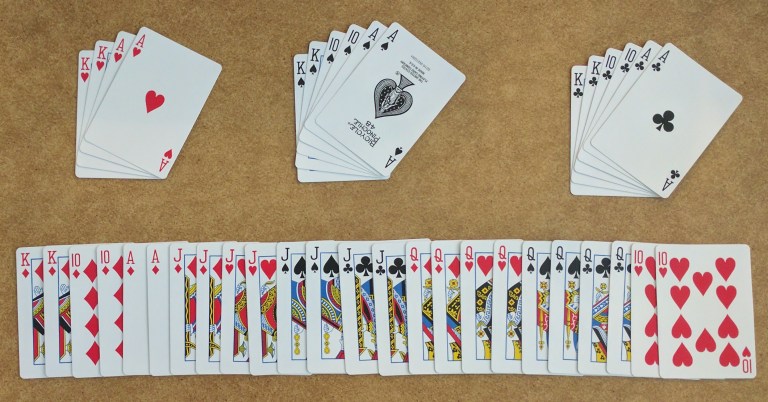
Doppelkopf 40-card deck courtesy of Openverse
It’s About the Cards: The contemporary decks of playing cards have evolved from these four suits. Various theories exist regarding the transformation of the suits into hearts, spades, diamonds, and clubs. One such theory posits that the suits symbolize the distinct social classes of the time: the clergy, the aristocracy, the military, and the peasantry.
Different Types of Decks: The two most common types of decks are the standard 52-card deck, and the 48-card Pinochle deck. There are others, but are very rare, and definitely special order.
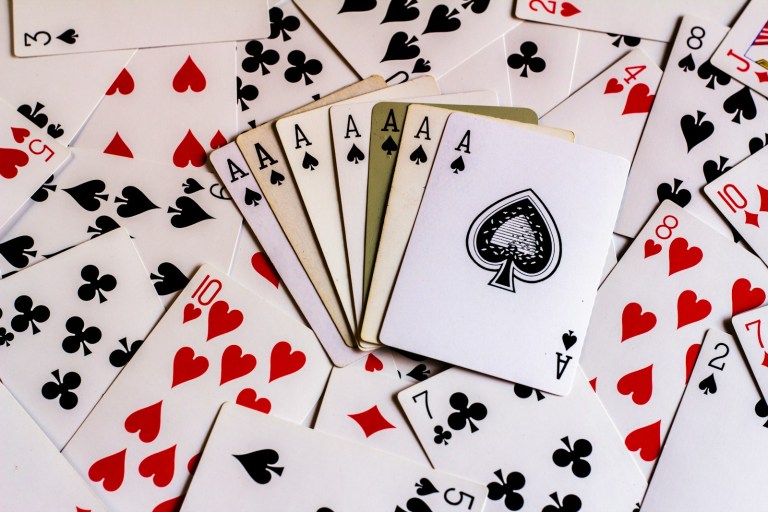
Photo by aceofnet on Unsplash
Sharp! A Card Sharp: A card sharp, also known in contemporary terms as a card shark, refers to an adept or cunning card player. Such individuals may employ techniques such as sleight of hand or various forms of deception to secure victory in a game.
Celebrated: National Card Playing Day, celebrated on December 28th, serves as an invitation to gather with friends and engage in a few rounds of card games.
Playing Card Ace of Spades courtesy of Openverse
A Few Facts:
I am sharing a few facts, and more, some trivia, some not trivial. . .
The Evolution of Card Playing:
| Popular Non-Tricking Card Games | |
| Deck Used |
Idea of Game |
| Poker (2-10 players) |
|
| Standard 52-card Deck | This game is widely regarded as the quintessential bluffing experience, with No Limit Texas Hold ‘Em gaining immense popularity through television broadcasts and local tournaments. Participants wager chips based on their belief in having the superior five-card poker hand. Many enthusiasts argue that the game is most enjoyable when played for monetary stakes, implying that the excitement lies in the gambling aspect rather than the mechanics of the game itself. Even in non-monetary settings, a semi-serious approach is necessary to ensure enjoyment; otherwise, it becomes too simple for a player to act recklessly and inadvertently grant victory to an opponent. This game is essential for those who appreciate the art of bluffing. Order of hand success statring at the highest ranked hand:Straight flush: Five cards of the same suit in sequential order. The order of cards in order of highest card is: Ace (at player’s discretion, played as low card), Deuce (2),3, 4, 5, 6, 7, 8, 9, 10, Jack, Queen, King, Ace (played as high card) The strength of a straight flush is determined by the value of the highest card.
|
| Blackjack (Maximum 7 Player) |
|
| Standard 52-card Deck | Blackjack is a card game in which players aim to achieve a hand value that is closer to 21 than that of the dealer, without exceeding this total. It is a widely enjoyed game in casinos and is generally played with one or more standard decks of cards.The following are some fundamental rules of blackjack:
|
| Blitz or Thirty-One (2-12 players) | |
| Standard 52-card Deck |
This widely enjoyed casual and social card game is also referred to as “Scat,” “Thirty-One,” “Ride the Bus,” and “Blitz.” Players take turns drawing and discarding cards, striving to enhance their three-card hand to achieve a total as close to 31 points in a single suit as possible. Blitz is instant win, and Knocking skips turn and the game goes one more round until the knocker reveals the hand. |
| Cheat (3-13 players) | |
| Standard 52-card Deck | Known by various names such as “I Doubt It” or “Bullsh**,” this game is a favorite among children. The objective is to be the first player to discard all of your cards, with the option to bluff about the cards being played. However, if a player is challenged and found to be dishonest, they must collect the entire pile of cards. |
| Egyptian Ratscrew (2-6 players) | |
| Standard 52-card Deck | This fast-paced slapping game resembles an intensified version of Slap Jack and is commercially available under the title Slamwich. |
| Fan Tan (3-6 players) |
|
| Standard 52-card Deck | Also referred to as “Sevens,” “Domino,” “Parliament,” and “Pay or Play,” this game involves players taking turns to play cards to a communal layout, starting with sevens as the foundation for each suit. Once a seven is placed, players can build up or down in that suit, aiming to be the first to play all their cards. |
| GOPS (2 players) | |
| Standard 52-card Deck | This straightforward and rapid bidding and bluffing game is designed for two players. The Diamonds serve as point cards, revealed one at a time in a random sequence. Each player is dealt an entire suit (Clubs or Spades) and plays a card of their choice, with the higher card winning the revealed point card. GOPS stands for “Game Of Pure Strategy,” emphasizing that the game relies entirely on skill rather than luck. |
| Knock Out Whist or Trumps (2-7 players) |
|
| Standard 52-card Deck | A streamlined version of Whist, where players aim to avoid elimination after each hand by winning at least one trick. The first hand consists of seven tricks, and the challenge increases as each subsequent hand features one less trick. This game serves as an excellent introduction to trick-taking mechanics. |
| Mao (2-7 players) | |
| Standard 52-card Deck | Particularly popular among college and university students since the 1960s, the goal of this game extends beyond merely winning; it emphasizes enjoyment. Essentially a variant of Crazy Eights, it incorporates unique rules and elements. |
| Big Two (4 players) | |
| Standard 52-card Deck | This game is ideally suited for four participants, although there are adaptations available for two to three players. Alongside President, which is mentioned earlier in this list, it stands out as one of the more approachable and widely recognized climbing games. The objective in climbing games is to be the first to discard all your cards, either playing them individually or in specific combinations. For those seeking a slightly simpler alternative to Big Two, Tien Len, the national card game of Vietnam, is worth considering. Tichu, a highly regarded climbing game, is also notable and was released commercially with a unique deck. |
| Canasta (4 players) |
|
| Standard 52-card Deck | Gaining immense popularity in the 1950s, Canasta employs two standard decks and is best played in partnerships of two players. This rummy-style game focuses on creating melds of seven cards of the same rank, with the ultimate goal of “going out” by playing all cards in hand. Various adaptations exist, including the well-known Hand and Foot variant. |
| Cassino (2-4 players) |
|
| Standard 52-card Deck | This traditional card game, often referred to as a “fishing” game, shares similarities with the simpler Scopa, which is mentioned earlier. The Anglo-American version enjoys particular popularity. Players aim to capture face-up cards from a communal pool by matching them with cards from their hand, either individually or by combining multiple cards to equal the value of the card played. Unlike Scopa, Cassino offers players more strategic options, including the ability to build cards for future use, enhancing the tactical aspect of the game. |
| Cribbage (2 players) |
|
| Standard 52-card Deck | A timeless card game centered around forming point-scoring combinations, the objective is to be the first to reach 121 points, which are tracked on a pegboard. Each player is dealt a hand of six cards and must place two into a “crib,” which will later contribute to the score of one of the players. Players take turns playing cards, adding their values until they reach or approach 31, and this process is repeated. Scoring occurs for combinations such as pairs, triples, runs, and cards that total 15, in addition to scoring for the hand at the conclusion of the round. Despite its casual appearance, the game requires significant skill, and seasoned players often excel. |
| Eleusis (4-8 players) |
|
| Standard 52-card Deck | This contemporary card game emulates the process of scientific inquiry, where participants, acting as “scientists,” engage in experiments to uncover the underlying rule that dictates gameplay. Players aim to eliminate their cards by discarding them; however, the “rule” that permits valid moves is established by the dealer and remains unknown to the players, who must deduce it through observation of legal plays. Rummy (2-6 players) – A traditional card game where players draw and discard cards in pursuit of creating “melds,” which generally consist of either sets of identical values or sequences of consecutive values. Numerous variations exist, including Gin Rummy, which is highly regarded and mentioned later in this list, along with commercially published games such as the Mystery Rummy series. Contract Rummy (3-5 players), an evolution of Rummy, introduces the added complexity of requiring players to meet different contractual obligations in each round, which consist of specific combinations of sets or runs that must be completed before melding. A commercial version of Contract Rummy is known as Phase Ten. |
| Nertz (2-6 players) |
|
| Standard 52-card Deck | Commonly referred to as “Racing Demon” or “Pounce,” Nertz is a fast-paced, competitive multiplayer solitaire game played in real time. The objective is to be the first to deplete cards from your Nertz piles by building upward on shared foundations. This game closely resembles the commercially available Ligretto/Dutch Blitz but is played using a standard deck of cards. |
| Spite & Malice (2-5 players) |
|
| Standard 52-card Deck | Commonly referred to as “Cat & Mouse,” this competitive patience or solitaire game accommodates two or more players and utilizes two decks of cards. It is more widely recognized under its commercially available variant, Skip-Bo. Unlike games such as Speed and Nertz, which are played in real time, this game is turn-based, although it shares a similar overall concept. |
| Zetema (2 players) |
|
| Standard 52-card Deck | This lesser-known Victorian card game has seen a resurgence in interest due to Sid Sackson’s A Gamut of Games. David Parlett endorses it as a unique card game that is “long and savory.” The game is played with a 65-card deck, consisting of 52 standard cards plus an additional two through Ace in one suit. Players aim to accumulate a specific number of points by discarding sets, completing tricks, forming marriages, or revealing flushes and sequences. It can also be played with four or six players in partnerships. |

Deck of Cards courtesy of Openverse
| Popular Tricking Card Games | |
| Deck Used |
Idea of Game |
| 500 (4 players) |
|
| Standard 52-card Deck | This is Australia’s national card game, characterized by its skillful trick-taking mechanics. Players engage in bidding to predict the number of tricks their partnership can secure. The individual who wins the bid is permitted to exchange several cards and designate the trump suit. The game offers numerous appealing elements, including the trick-taking aspect, the bidding process, the strategic card exchange with the kitty to enhance one’s hand, and the partnership play. A variant designed for three players is also available. |
| Bezique (2 players) |
|
| Standard 52-card Deck | This is a traditional trick-taking game for two players that originated in France and gained significant popularity in the early 20th century. It shares some similarities with the two-player variant of the American game Pinochle. |
| Bridge (4 players) | |
| Standard 52-card Deck |
Recognized as the quintessential classic among trick-taking card games, Bridge is played in partnerships and allows for a high level of strategic play. Contract Bridge is frequently played in organized club environments, featuring a comprehensive array of bidding conventions and gameplay strategies that may require considerable time to master for effective play. |
| Briscola (2-6 players) | |
| Standard 52-card Deck | An Italian trick-taking game that is relatively simple to learn and particularly enjoyable as a two-player game. Utilizing only 40 cards, the objective is to win tricks from a hand of three cards to acquire point-scoring cards. The five-player variant known as Briscola Chiamata is reportedly especially engaging. |
| Euchre (4 players) | |
| Standard 52-card Deck | This game enjoys immense popularity as a social activity in various regions of Canada and the USA, and it can be particularly entertaining in a casual tournament format. The game employs just 24 cards, with the Jacks serving as powerful “bowers.” One partnership aims to secure the most tricks from a five-card hand, with the trump suit determined by a revealed card. Ecarte (2 players) is a highly regarded trick-taking game that closely resembles Euchre but is more suitable for two players. |
| German Whist (2 players) |
|
| Standard 52-card Deck | This is an excellent two-player game in the Whist style. Each participant holds a hand of 13 cards, and the initial phase involves each player playing a card to compete for the face-up card from the top of the stock, with the first card revealed establishing the trump suit. |
| Hearts (3-7 players) | |
| Standard 52-card Deck | This game is a timeless classic in the realm of trick-taking games, where the objective is to avoid winning tricks that contain Hearts, as these incur negative points. Additionally, capturing the Queen of Spades results in a significant penalty of 13 negative points. There is no trump suit in play. |
| Jass (2-4 players) |
|
| Standard 52-card Deck | Recognized as the national game of Switzerland, Jass can be played by two individuals or in partnerships. It belongs to the Jass family, which has its roots in the Netherlands. This family also encompasses games such as Belote (French), Klabberjass/Clob (German), and Klaverjassen (Dutch). Swiss Jass shares similarities with Bezique and Pinochle. |
| Le Truc (2 players) | |
| Standard 52-card Deck | This unique game of betting, bluffing, and trick-taking hails from 19th century France and utilizes a 32-card deck. It gained popularity following its inclusion in Sid Sackson’s Gamut of Games. Players engage in a clever bluffing strategy, using a hand of three cards to play three tricks, while having the opportunity to enhance the value of their hand throughout the game, potentially leading their opponent to fold. It is important to note that there are some variations in the rules. Both the French version of Le Truc and the Spanish variant, Truc (which accommodates two-player partnerships), are derived from the older English game Put (2 players), a simpler bluffing game that is also worth recommending. |
| Ninety-Nine (3 players) | |
| Standard 52-card Deck | Created by David Parlett, this game is celebrated as one of the finest trick-taking games designed specifically for three players. It employs a 36-card deck, and each player, from a hand of 12 cards, sets aside three cards to indicate their bid. The remaining nine cards are played in tricks, with the goal of winning precisely the number of tricks that corresponds to their bid. |
| Oh Hell (3-7 players) |
|
| Standard 52-card Deck | This game is known by various names, including Up and Down the River, Bust, and other less favorable titles that are variations of Oh ***. It is an engaging trick-taking game where players bid on the number of tricks they believe they can win, with the hand size fluctuating in each round. The game allows for significant skill, as players can score points even with unfavorable cards if they make accurate bids. Numerous scoring variations exist, one of which has been commercially published under the name Wizard. |
| Pinochle (4 players |
|
| 48-card Pinochle Deck | This esteemed and traditional American trick-taking game is designed for partnerships and utilizes a 48-card deck. The game commences with an auction where players bid on the number of points their team anticipates winning, with the highest bidder selecting the trump suit. Each participant is dealt a hand of 12 cards, with individual cards and specific combinations (melds) contributing to the overall point total. Additionally, there exists a two-player variant of Pinochle that employs a single deck. |
| Pinochle (4 players) |
|
| Standard 52-card Deck | This esteemed and traditional American trick-taking game is designed for partnerships and utilizes a 48-card deck. The game commences with an auction where players bid on the number of points their team anticipates winning, with the highest bidder selecting the trump suit. Each participant is dealt a hand of 12 cards, with individual cards and specific combinations (melds) contributing to the overall point total. Additionally, there exists a two-player variant of Pinochle that employs a single deck. |
| Piquet (2 players) |
|
| Standard 52-card Deck | This historic game boasts a lineage that spans several centuries. Although it presents certain antiquated complexities, it remains a favored choice and is esteemed as one of the finest and most skillful card games for two players. |
| Pitch (4 players) |
|
| Standard 52-card Deck | Originating from the traditional English game All Fours, Pitch has gained significant popularity in various regions of the United States, leading to numerous adaptations. Typically played in partnerships, the game begins with a bidding phase after players receive six cards, during which they bid on four specific objectives they believe they will achieve by the end of the hand: High trump, trick with low trump, trick with the Jack of trumps, and the highest total point value. |
| Rook (4 players) |
|
| Standard 52-card Deck | Rook is an engaging partnership trick-taking game that incorporates bidding and has been commercially published with a specialized deck. The objective is to secure tricks containing point cards (for instance, the Rook, or Joker card, is valued at 20 points) rather than merely winning the most tricks. The highest bidder selects the trump suit and has the option to exchange cards with the “nest/kitty” to enhance their hand. Several notable variations exist, and in certain regions of Canada, one such variation is known as 200 (in French: Deux Cents). |
| Schnapsen (2 players) |
|
| Standard 52-card Deck | Widely enjoyed across various regions of Europe, Schnapsen holds the distinction of being Austria’s national card game. This traditional trick-taking game for two players boasts a rich history and encourages skillful and strategic play. Utilizing a compact deck, one of its unique features is the scoring system for “marriages,” which refers to pairs of Kings and Queens. For an in-depth comparison of the closely related game Sixty Six and the various rule variations of Schnapsen, please refer to the provided links. |
| Skat (3 players) |
|
| Standard 52-card Deck004 |
Recognized as Germany’s national card game, Skat is a classic trick-taking game that involves intricate scoring and bidding mechanics. It stands out as one of the premier card games for three players. A simpler alternative with more straightforward bidding and scoring is Schafkopf, which has been adapted and popularized in the United States as Sheepshead by immigrants. Another related game is the challenging Doppelkopf, also known as Double Sheepshead. |
| Spades (4 players) | |
| Standard 52-card Deck | Esteemed as one of the finest trick-taking games for partnerships, Spades emerged and gained popularity in the United States during the 1930s. In this game, Spades are designated as the trump suit, and players must predict the number of tricks they anticipate winning before the game begins. While the bidding and scoring may present challenges for newcomers to trick-taking games, Spades offers a level of skill that surpasses more casual games such as euchre. |
| Whist (4 players) | |
| Standard 52-card Deck | A straightforward yet classic trick-taking card game, Whist serves as the foundation for many other card games. Played in partnerships, this game does not utilize a trump suit, and teams aim to secure the highest number of tricks throughout a complete hand of 13 cards. Notable variations include German Whist (for 2 players) and Knock Out Whist (suitable for 3 to 7 players). |

solitaire courtesy of Openverse
| Popular Solitaire Card Games | |
| Deck Used |
Idea of Game |
| Klondike Solitaire |
|
| Standard 52-card Deck | Klondike is the most popular version of Solitaire, often referred to simply as “Solitaire. ” It likely began during the 19th-century gold rush in Klondike, Canada. Its popularity soared after being included in Microsoft’s Windows 3. 0 in 1990. The game uses a 52-card deck. The objective is to sort cards by suit from Ace to King in empty areas known as foundations. Cards are dealt into 7 piles on the tableau, with only the top card showing. Players must create sequences in descending order and alternating colors to reveal lower cards. Kings can fill empty tableau spaces. Remaining cards are kept in a Stock pile for play. |
| FreeCell |
|
| Standard 52-card Deck | Out of the different types of Solitaire games, FreeCell Solitaire is the most similar to Klondike but is more strategic. It has about a 99% solvable probability. FreeCell uses a single deck, dealing cards into 7 piles with all cards visible and no Stock pile. The goal is to build foundations by suit. Sequences are built by suit in ascending order for foundations and in descending order with alternating colors in the tableau. The main difference is the presence of 4 empty spaces called free cells, where cards can be placed to access those underneath. Cards in free cells can only be used to build sequences, not exchanged. |
| Spider | |
| Standard 52-card Deck |
Although Klondike is the most popular version of Solitaire, Spider Solitaire is the top choice among 2-deck Solitaire types. It is named for the 8 foundations needed to win, like a spider’s 8 legs. Players have about a 1 in 3 chance of winning a Solitaire Spider game. Game-play involves two card decks and can use one or more suits based on difficulty. The setting resembles Klondike, with piles, a Stock pile, and foundations, but all cards are exposed. The goal is to create suit sequences from King to Ace. Tapping the Stock pile adds an extra card to each pile. |
| Tripeaks | |
| Standard 52-card Deck | Tripeaks is named for the three pyramid peaks created by the card layout and is also known as Three Peaks, Tri Towers, and Triple Peaks. It was created by Robert Hogue in 1989, who found that over 90% of Tripeaks games can be won. The game uses a standard 52-card deck, arranged in three pyramids of four rows, with the base cards facing up. The objective is to clear all cards from the tableau by forming sequences of cards that are one point higher or lower than the previous card, regardless of their suit. Removed cards go to a discard pile, and the top card there starts the next sequence. Players can use the Stock pile when no moves are left. |
| Pyramid | |
| Standard 52-card Deck | Pyramid Solitaire is named for its pyramid-shaped layout of cards. Despite its simple rules, it has a low winning probability, especially when players can only draw from the Stock pile once, giving them about a 1 in 50 chance of winning. In the game, 28 cards are arranged in a pyramid, and players pair cards to reach a total of 13 points. Kings are worth 13, Queens 12, and Jacks 11. Players can draw one card at a time from the Stock pile to find matches for the pyramid’s exposed cards, with the game’s difficulty varying based on Stock pile access. |
| Yukon |
|
| Standard 52-card Deck | Yukon Solitaire is a challenging card game inspired by Klondike but with different rules. The aim is to build four foundations by suit, starting from the ace to the king. Players work with a shuffled 52-card deck laid out in seven piles, all cards visible except for the bottom one to six cards in each pile. Unlike Klondike, there is no Stock pile or hints. Cards can be moved onto free cards without needing a sequence, and the goal is to organize them into ascending suit sequences on the foundations. |
| Baker’s Dozen | |
| Standard 52-card Deck | This game utilizes a standard deck of 52 cards, which are arranged into 13 piles (referred to as a baker’s dozen), all oriented face up. The Kings are consistently positioned at the base of each pile. The objective is to construct the foundations in ascending order from Ace to King. Only the top cards of the piles are eligible for movement, and it is not permissible to shift sequences within the piles. The suit of the cards does not influence the formation of sequences in the tableau. |
| Forty Thieves |
|
| Standard 52-card Deck | Forty Thieves is played with two decks of 52 cards each. The cards are distributed into 10 piles, each containing 4 cards (representing the 40 thieves obstructing victory). All cards are laid face up. Players must create 8 foundations on the tableau, building suit sequences in ascending order. Within the piles, sequences must be arranged in descending order and must consist of cards of the same suit. Only one card may be moved at a time, and moving sequences is not allowed. Any card can fill empty spaces. Players are permitted to access the Stock pile only once. |
| Golf | |
| Standard 52-card Deck | Golf Solitaire is a card game that merges the thrill of golf with the intricate elements typically associated with online Solitaire games. The primary aim is to clear the tableau by pairing cards that are either one value higher or lower than the preceding card. |
| Scorpion | |
| Standard 52-card Deck | With an average win rate of only 5%, Scorpion Solitaire ranks among the most difficult Solitaire games available. Its layout resembles that of Solitaire Spider, where players must create complete descending sequences of the same suit on the tableau before transferring the cards to the foundations. However, the gameplay diverges significantly. Any card can be moved, irrespective of its position within the piles, but it may only be placed atop a free card. This flexibility in movement, rather than simplifying the game, actually constitutes its most formidable challenge. |
| Crescent |
|
| Standard 52-card Deck | Crescent Solitaire presents a formidable challenge, demanding considerable strategic planning and a strong memory from its players. The game features foundations positioned at the center of the tableau, with one set commencing with the Aces and the other with the Kings. This arrangement necessitates that players construct both ascending and descending sequences concurrently. The remaining cards are arranged in a crescent shape surrounding the foundations. Only the top cards and those directly beneath them are visible, compelling players to maneuver the cards by stacking them in piles with ranks that are either one higher or one lower. This process allows players to examine the remaining cards in a specific pile to locate the ones they require. While the rules may appear straightforward, players soon discover the complexities involved in mastering this game. |
| Canfield |
|
| Standard 52-card Deck | Canfield Solitaire experienced a revival in popularity during the 20th century, largely attributed to casino proprietor Richard A. Canfield. However, this card game has a much older history, previously known as Demon Patience, a name that aptly reflects its challenging nature. Despite its uncomplicated layout and rules, Canfield is not a game for those who play without thought. It demands significant strategic consideration, as players often find it necessary to dismantle or forfeit the foundations to create sequences that will unlock the Stock pile or reveal the face-down cards on the table. |
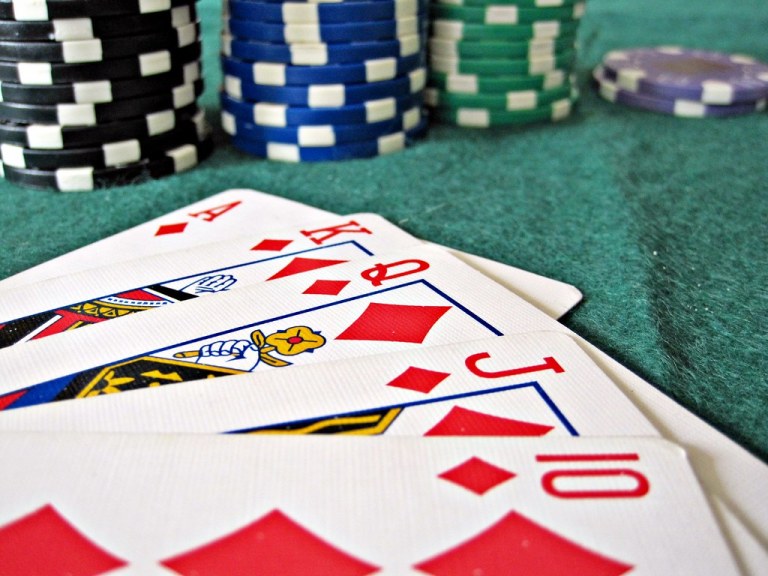
Poker courtesy of Openverse
More Trivia: Here is some other great playing card trivia. . .
- The Four Suits in a Standard Deck of Cards: The four suits found in a standard deck of cards are hearts, clubs, diamonds, and spades. Each suit comprises thirteen cards, which include the ace, cards numbered two through ten, and three face cards. Additionally, the presence of two jokers increases the total number of cards in the deck to 54.
- The Largest Card Maker in the World: The largest manufacturer of playing cards globally is the United States Playing Card Company, renowned for producing Bicycle brand playing cards.
- How Many Decks of Cards are Used at Las Vegas Every Year? In Las Vegas, it is estimated that around 27 million decks of cards are utilized annually.
The Present:
People all over the world, including the U.S. are enjoying playing card games: with and without fellow players, every day!
The Future:
Let’s give thanks and enjoy playing a card game, this great year and in years to come. . .

Photo by WikimediaImages courtesy of Pixabay
FREEBIES & DEALS For Card Playing Day:
♠️ FREE National Card Playing Day: Fonts
♦️ FREE: National Card Playing Day: Crafts + Printable
♣️ FREE National Card Playing Day: Sheet music
♥️ CHEAP: National Card Playing Day: Ideas, Crafts & Worksheets
♠️ FREE National Card Playing Day: AT “Hey It’s Free”
Hashtags:
#HappyCardPlayingDay #HappyNationalCardPlayingDay #CardPlayingDay #NationalCardPlayingDay #CardGame #PlayingCards #PlayingCard #Cards #Card #Deck #DeckOfCards #UseYourCards #SleightOfHand #CardCollection #Cardist #Poker #Ellusionist #CardCollector #PlayingCardCollectors #PlayingCardsDesign #PlayingCardDecks #FontaineCards #PlayingCardsCollection #CustomPlayingCards #BicycleCards #BicyclePlayingCards #RarePlayingCards #PokerCards #CardistryPlanet #CardMagic #Magic #Magician #CardMagician #Magicians #MagicTricks #CardTricks #MurphysMagic #MagicTrick #CardTrick #StreetMagic #CloseUpMagic #MarkedCards #MagicPlayingCard #PlayingCardCollection #PlayingCardCollector
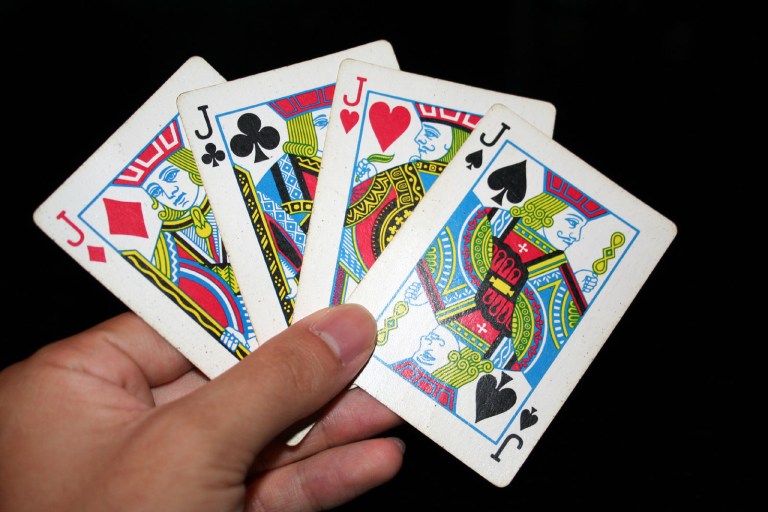
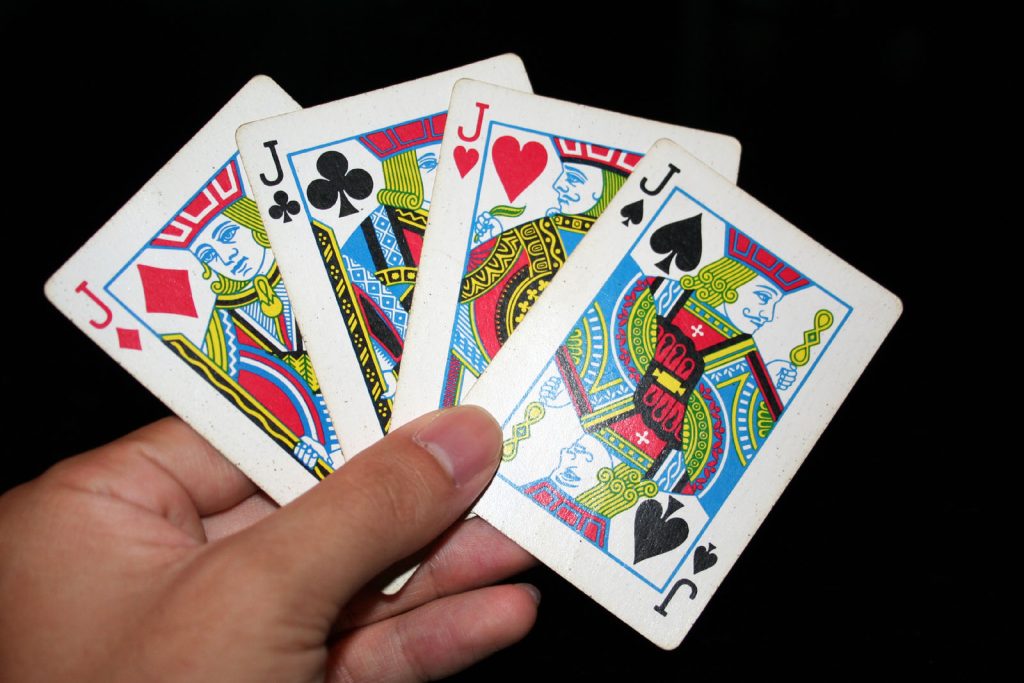
Jack playing cards courtesy of Openverse
National Card Playing Day































I like to play cards. I’ve been thinking of playing BINGO this year too,
gin rummy is my fave!