Happy Utah Day!
Today is National Utah Day for 2025. . .
Happy National Utah Day ! ! !

Which State is UT:
The Beginning Years: It is believed that Utah’s ancient history features diverse indigenous cultures that date back thousands of years. The first inhabitants were Paleo-Indians, followed by the Fremont and Ancestral Puebloan (Anasazi) cultures, who created settlements and left artifacts and rock art. Later, groups like the Shoshone, Ute, and Navajo also settled in Utah. Archaeological finds show human presence in Utah for over 5,000 years. The Paleo-Indians were hunter-gatherers, while the Archaic Period, lasting around 8,000 years, showed a shift to gathering in a drier climate. The Desert Archaic people utilized nearby resources. The Fremont culture appeared around 300 BC, thriving in Northern Utah for about a thousand years, while the Ancestral Puebloan culture, famous for cliff dwellings, flourished in Southern Utah from 1 to 1300 AD. Both created villages, farmed, and made art. From 1250 AD to the 1700s, the Late Prehistoric period included groups like the Goshute, Paiute, Shoshone, Navajo, and Ute. European explorers began to arrive in the 16th century, with Spanish priests Atanasio Dominguez and Silvestre Escalante visiting in 1776, followed by mountain men, trappers, and Mormon pioneers in 1847.

postcard: 1947 utah courtesy of Openverse
More History: With the state of Utah having had Mexico gain independence from Spain in 1821, it claimed parts of the area until the United States won the Mexican-American War and acquired Utah in 1848. Mormon pioneers arrived in 1847, settled Salt Lake City, and proposed a large territory called Deseret. Utah became a U. S. territory in 1850 and achieved statehood as the 45th state in 1896. The Utah War occurred due to conflicts with the U. S. government, and the Transcontinental Railroad completed in 1869 boosted immigration. Utah’s economy grew in the 20th and 21st centuries, benefiting from mining, tourism, and technology.
Climate of Utah: Utah has a climate is known for its vastly differentiating climate, mainly arid, semi-arid, and desert, with large temperature differences across the state. It experiences four seasons with varying precipitation based on altitude and location. Much of Utah is semi-arid, having hot summers and cold winters. Higher elevations are cooler than lower areas, like Salt Lake City, where summer highs can exceed 90°F and nighttime lows are in the mid-50s°F to mid-60s°F. Mountains block moisture, causing arid conditions. Precipitation varies, with the northwest being wetter in winter and spring, while summer brings storms in the east and south. The Great Salt Lake contributes to a lake-effect snow in certain nearby areas. Utah has approximately 238 days per year being sunny, with approximately 65% of days being sunny.
More About Utah: Throughout the years, Utah has earned the titles of the being famous for its beautiful natural scenery, especially its five national parks: Arches, Bryce Canyon, Canyonlands, Capitol Reef, and Zion. The state is also recognized for skiing, the Great Salt Lake, the Sundance Film Festival, and the Mormon religion. Utah has five iconic national parks that offer diverse landscapes and activities. The state is known for its world-class ski resorts in the Wasatch Range, making it a favorite for winter sports. The Great Salt Lake is an important feature of Utah’s ecosystem. The Sundance Film Festival is a key event for independent films, while Utah has a strong connection to the Mormon faith and its historical significance.
The Great Location of Utah: The state of Utah spans 350 miles in length north to south, and a width of 270 miles from east to west, making Utah the 11th largest state in the United States. It is bordered by Idaho to the north, Wyoming to the northeast, Colorado to the east, adjacent with the 4-corners state of New Mexico to the southeast, Arizona to the south, and Nevada to the west.
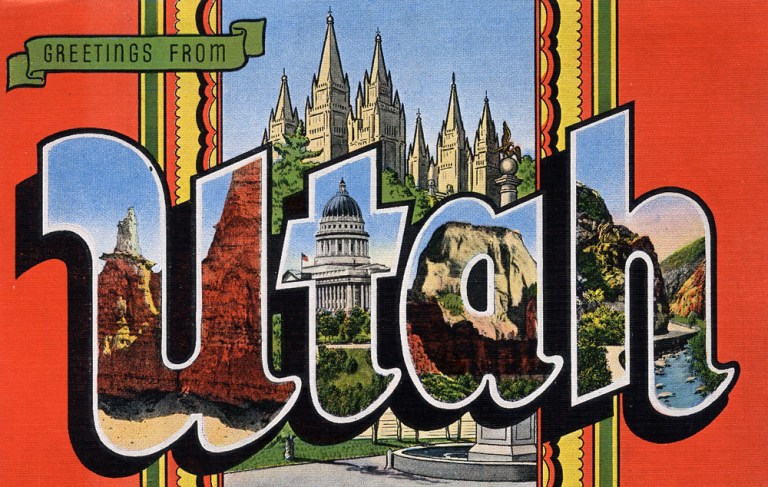
Greetings from Utah – Large Letter Postcard courtesy of Openverse
Utah’s Statehood Facts:
- Date: 01/04/1896
- Capital: Salt Lake City
- Population: 3,504,000 (2023)
- Size: Land area of 82,144 square miles; Total area of 84,899 square miles
- Nickname: The Beehive State
- State Motto: Industry
- Tree: Quaking Aspen (Populus Tremuloides)
- Flower: Sego Lily (Calochortus Nuttallii)
- Bird: California Gull (Larus Californicus)
The History:
| Utah Officially Adopted as a U.S. State, State Song, Admission Date & Utah Flag | |||
| State Name Info ♪ State Song ♫ |
Admission |
Capital | Flag Image |
| 45th State. Utah Territory “The Beehive State” by Randy Newman (Modern), “Utah…This Is the Place” written by Sam and Gary Francis (Original) |
01/04/1896 | Salt Lake City | |
See: Officially Adopted as a U.S. States, State Songs, Admission Dates & Flags at:
Some Great Utah Sites: Here is a list of some some great places to visit while in Utah:
- Bryce Canyon National Park, Hwy. 63. Bryce, UT 84764
- Arches National Park, 5 miles north of Moab, Utah, on US 191, Moab, UT 84532
- The Narrows, within Zion National Park, 1 Zion Park Blvd, Springdale, UT 84767
- Big Cottonwood Canyon, 8073 Big Cottonwood Canyon Rd, Brighton, UT 84121
- Zion National Park, 1 Zion Park Blvd, Springdale, UT 84767
- Monument Valley Navajo Tribal Park, U.S. 163 Scenic, Oljato-Monument Valley, UT 84536
- Dead Horse Point State Park, State Rt. 313, Moab, UT 84532
- Angel’s Landing, 1 Zion Park Blvd, Springdale, UT 84767
- Temple Square, 50 North Temple, Salt Lake City, UT 84150
- Canyonlands National Park, at the end of UT 211, about 35 miles west of US 191, Moab, UT 84532
- Deer Valley Resort, 2250 Deer Valley Dr S, Park City, UT 84060
- Forrest Gump Point, US-163 Scenic, Mexican Hat, UT 84531
Memorable Utah Events: Here is a list of some events that happened in Utah:
- 1500: The Anasazi people lived in the region.
- 1300: The Anasazi people disappear.
- 1600s: Native American tribes such as the Ute and Shoshone inhabit the land.
- 1765: Spanish explorer Juan Antonio de Rivera visits the area.
- 1776: Franciscan priests explore the land looking for a passage to California.
- 1821: Mexico becomes independent from Spain and takes control of Utah.
- 1824: Jim Bridger becomes the first European to see the Great Salt Lake.
- 1847: The Mormons arrive and found Salt Lake City.
- 1848: Utah becomes part of the United States after the Mexican-American War.
- 1849: The Mormons found the state of Deseret.
- 1850: The Utah Territory is established by the U.S. Congress.
- 1861: The First Transcontinental Telegraph is connected in Salt Lake City.
- 1869: The First Transcontinental Railroad is completed at Promontory Summit.
- 1896: Utah is admitted as the 45th state.
- 1919: Zion National Park is established.
- 1964: The Flaming Gorge Dam is completed.
- 2002: The Winter Olympics are held in Salt Lake City.

Utah Vacation 2010 courtesy of Openverse
FREEBIES & DEALS For National Utah Day:
FREE National Utah Day: Fonts
FREE: National Utah Day: Crafts + Printable
CHEAP: National Utah Day: Ideas, Crafts & Worksheets
FREE: National Utah Day: AT “Hey It’s Free”
Hashtags:
#HappyNationalUtahDay #NationalUtahDay #HappyUtahDay #Utah #ZionNationalParK #BryceCanyon #SaltLakeCity #SaltLakeCityUT #Bryce #BryceUT #Moab #MoabUT #Springdale #SpringdaleUT #CedarCity #CedarCityUT #Brighton #BrightonUT #UT
National Utah Day
More on Versatileer:
![wp-17318091530192645008364056419715.jpg]()
Featured Photo & Video: The Beauty of Fall Color – Beech Tree
11/16/2024![20211101_165342.jpg]()
Featured Photo: The Beauty of Fall Color – The Northern Red Oak Tree
11/18/2022![wp-16978407480751811778554941698393.jpg]()
Featured Photo & Video: The 31 Days of Halloween – Day 21: Bone Yard Fun formerly Wild House, Worth
10/21/2023![Coronet '3-D'.jpg]()
Happy National 3-D Day – 2025
03/21/2025![17093744678576611064403910018610.jpg]()
Featured Photo: St. Patrick's Flower of the Day ’24 – Bouquet #3
03/07/2024