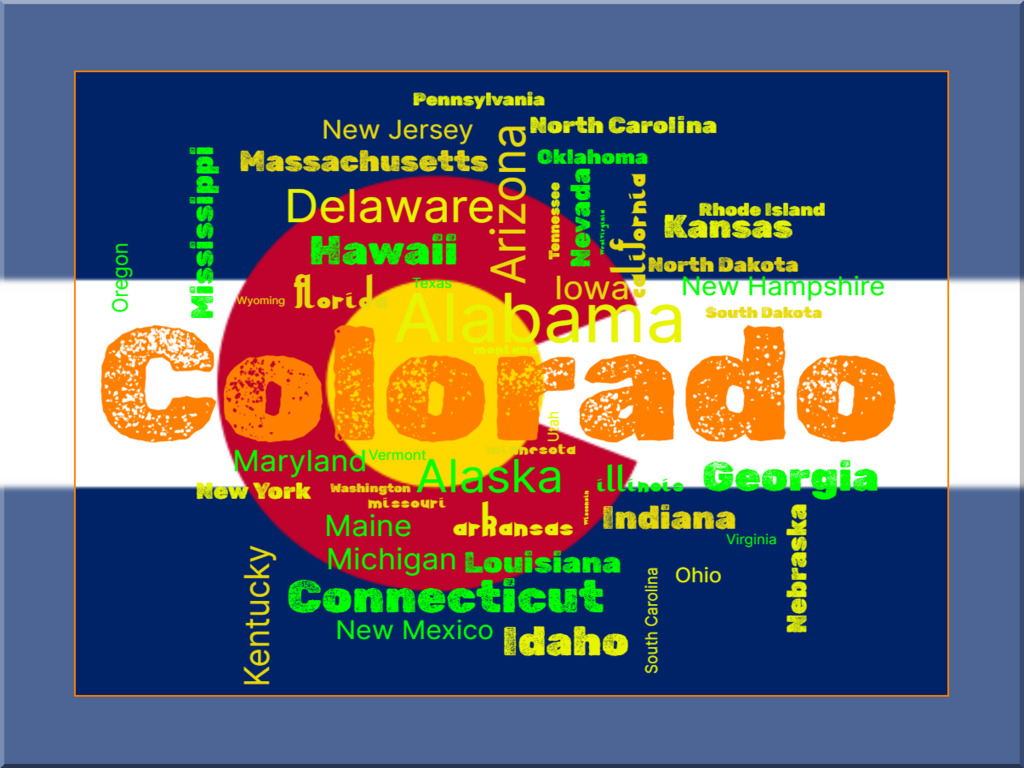
Happy Colorado Day!
Yesterday was National Colorado Day for 2025. . .
Happy National Colorado Day ! ! !

Which State is CO:
The Beginning Years: It is believed that Colorado’s initial settlement in ancient history goes back over 5,000 years, with Paleo-Indians believed to be the first inhabitants. The Ancestral Puebloans, known for their impressive cliff dwellings and farming in Mesa Verde, emerged after them around 500 A.D. In 1598, Spanish conquistador Juan de Onate claimed the southern region. Various Native American tribes, including Apache, Navajo, Ute, Comanche, and Cheyenne, lived in the area from the 16th to 18th centuries. Important historical sites include Mesa Verde National Park and the Lindenmeier Site. The Ute are among the oldest residents, and the Sand Creek Massacre occurred in 1864.

State of Colorado courtesy of Openverse
More History: Colorado, known as the “Centennial State,” became a state on August 1, 1876, coinciding with the 100th anniversary of the United States. Its history includes significant events such as the gold rush that began in 1858, leading to the founding of Denver. Colorado was designated a territory in 1861, illustrating its growing population and importance. The motto “Pikes Peak or Bust” captured the aspirations of fortune seekers. Although Congress considered naming it “Idaho,” it became the 38th state in 1876. Key issues like the Colorado Coalfield War from 1913-1914, the 1976 refusal of the Olympics, the tragic Columbine High School massacre in 1999, and the rise of the Chicano Movement in the 1960s and 70s marked its history. Additionally, the world’s first rodeo was held in Deer Trail in 1869, and Denver is also believed to be the birthplace of the cheeseburger.
Climate of Colorado: Colorado has a climate is known for its cool, dry, and refreshing climate due to its high elevation and continental geography. The state sees large temperature changes throughout the seasons and days, with low humidity making it feel comfortable even on hot days. Key characteristics of Colorado’s climate include high altitude, a continental climate, and distinct seasons featuring cold winters, warm summers, and colorful autumns. The Rocky Mountains create diverse microclimates, and precipitation varies, with mountains getting more snow than plains. The state enjoys over 300 days of sunshine a year, with specific regional variations including semi-arid eastern plains and cooler mountain regions, with approximately the nicely high 82% of days being sunny.
More About Colorado: Throughout the years, Colorado is known for its beautiful landscapes and outdoor activities, especially being the high point of the Rocky Mountains in the continental United States. Key parks include the Rocky Mountain National Park with high peaks and wildlife, Great Sand Dunes National Park featuring North America’s tallest sand dunes, Black Canyon of the Gunnison National Park for its striking landscape, and Mesa Verde National Park with ancient cliff dwellings. Popular activities include skiing and snowboarding in resorts like Aspen, hiking, biking, and whitewater rafting. Denver, the state capital, is noted for its culture and food scene. Colorado has a vibrant craft beer industry with many award-winning breweries. The state honors its western heritage through events like the National Western Stock Show, offers hot springs and spa towns, and has diverse wildlife such as elk and bighorn sheep. Red Rocks Park and Amphitheatre is a special outdoor music venue with scenic rock formations.

1895 Railroad Map of Colorado courtesy of Openverse
The Dust Bowl: The “Dust Bowl” was a dreaded phenomenon that was the largest weather disaster that was directly caused by decades of ill activity man created by lack of the proper knowledge skills to preserve a land’s environment. For decades leading up to the disaster, mankind kept using the disk plow which dug too deep into the soil of the plains and pulverized the dirt and made in featherlight. To make matters worse, mankind kept digging up the grassland to plant for aid to economic depression of both Europe and the United States, with legislation to pay farmers more than the value of the crops. The Dust Bowl also was brought on by natural effects of extended drought and unusually high temperatures. Poor agricultural practices and the resulting wind erosion all contributed to making the Dust Bowl. President Herbert Hoover then finally admitted it was a disaster when the winds blew the dust all the way to Washington D.C. U.S. Congress established the Soil Erosion Service and the Prairie States Forestry Project in 1935. The Dust Bowl effected Kansas and other U.S. States. A great book with the subject of the Dust Bowl is listed here:


My Rating ★★★★★
See my review on the following post: The Worst Hard Time: The Untold Story of Those Who Survived the Great American Dust Bowl by Timothy Egan. Please see my excellent five star review on this great book!
The Great Location of Colorado: The state of Colorado spans 380 miles in length, east to west and 280 miles width, north to south miles in length. It is bordered by Wyoming to the north, Nebraska to the north and east, Kansas to the east, Oklahoma and New Mexico to the south, (kitty-corner to Arizona with the only 4-corners in the United States) and Utah to the west.

Greetings from Colorful Colorado, The Switzerland of America – Large Letter Postcard courtesy of Openverse
Colorado’s Statehood Facts:
- Date: 08/01/1876
- Capital: Denver
- Population: 5,957,000 (2024)
- Size: Land area of 103,718 square miles; Total area of 104,185 square miles
- Nickname: The Centennial State & Colorful Colorado
- State Motto: Nil Sine Numine Latin for “Nothing without Providence”
- Tree: Blue Spruce (Picea Pungens)
- Flower: Rocky Mountain Columbine (Aquilegia Caerulea)
- Bird: Lark Bunting (Calamospiza Melanocorys)
The History:
| Colorado Officially Adopted as a U.S. State, State Song, Admission Date & Colorado Flag | |||
| State Name Info ♪ State Song ♫ |
Admission |
Capital | Flag Image |
| 38th State. Colorado Territory “Rocky Mountain High” by John Denver (Modern), “Where the Columbines Grow” A.J. Fynn (Original) |
08/01/1876 | Denver | |
See: Officially Adopted as a U.S. States, State Songs, Admission Dates & Flags at:
Some Great Colorado Sites: Here is a list of some some great places to visit while in Colorado:
- Garden of the Gods, 1805 N. 30th Street, Colorado Springs, CO 80904
- Denver Botanic Gardens, 1007 York St, Denver, CO 80206
- Red Rocks Park and Amphitheatre, 18300 W Alameda Pkwy, Morrison, CO 80465
- Durango & Silverton Narrow Gauge Railroad & Museum, 479 Main Ave, Durango, CO 81301
- Pikes Peak: America’s Mountain, 5089 Pikes Peak Hwy, Cascade, CO 80809
- Mount Blue Sky, Mount Blue Sky Rd., Bailey, CO 80439
- Denver Museum Of Nature & Science, 2001 Colorado Blvd, Denver, CO 80205
- Denver Union Station, 1701 Wynkoop Street, Denver, CO 80202
- Cave of the Winds Mountain Park, 100 Cave of the Winds Rd, Manitou Springs, CO 80829
- Trail Ridge Road, 1000 US Hwy 36. Estes Park, CO 80517
- Cheyenne Mountain Zoo, 4250 Cheyenne Mountain Zoo Rd, Colorado Springs, CO 80906
- Coors Field, 2001 Blake St, Denver, CO 80205
Memorable Colorado Events: Here is a list of some events that happened in Colorado:
- 500: The Anasazi culture develops in the region.
- 1541: Spanish explorer Francisco de Coronado visits Colorado.
- 1682: French explorer Robert de La Salle claims the land for France.
- 1803: The United States buys eastern Colorado from France as part of the Louisiana Purchase.
- 1806: American explorer Zebulon Pike follows the Arkansas River through Colorado.
- 1821: The Santa Fe Trail opens.
- 1833: Fort Bent is established as the first permanent settlement.
- 1848: The United States acquires western Colorado from Mexico after the Mexican-American War.
- 1858: Gold is discovered near Pikes Peak.
- 1858: Denver City is established.
- 1861: The Colorado Territory is formed by the U.S. Congress.
- 1864: The Sand Creek Massacre occurs and many Cheyenne and Arapaho are killed.
- 1867: Denver City becomes the capital of the territory.
- 1870: The Denver Pacific Railway reaches Denver.
- 1876: Colorado is admitted to the Union as the 38th state.
- 1894: Colorado becomes the second state to give women the right to vote.
- 1906: The Denver Mint issues its first coins.
- 1958: The Air Force Academy opens near Colorado Springs.

Photo by Christophe Laurenceau on Unsplash
FREEBIES & DEALS For National Colorado Day:
FREE National Colorado Day: Fonts
FREE: National Colorado Day: Crafts + Printable
CHEAP: National Colorado Day: Ideas, Crafts & Worksheets
FREE: National Colorado Day: AT “Hey It’s Free”
Hashtags:
#HappyNationalColoradoDay #NationalColoradoDay #HappyColoradoDay #Colorado #Denver #DenverCO #ColoradoSprings #ColoradoSpringsCO #Pueblo #PuebloCO #Boulder #BoulderCO #GrandJunction #GrandJunctionCO #Breckenridge #BreckenridgeCO #MountBlueSkyScenicByway #PikesPeak #RockyMountains #RockyMountainStates #CO

National Colorado Day
More on Versatileer:
![Greetings from Arkansas - Large Letter Postcard (12730259665).jpg]()
Happy National Arkansas Day – 2026
01/11/2026![Yankee-Woods-Winter-2-27-84-1.png]()
Featured Photo: Winter Weather Special – Yankee Woods - Winter 1984
02/23/2022![wp-17292030302423365231664357162552.jpg]()
Photos: Full Hunter’s Super Moon on October 16th to 17th
10/17/2024![INSTA_BehindtheMirror.png]()
Ends 11-05 – Behind the Mirror by Bridget Budd Book Blitz + $100 Amazon Gift Card Giveaway
11/02/2025![wp-17051175198798171457770661183047.jpg]()
Featured Photo & Video: Winter Weather Special – Slow & Relaxing Snowfall on Evergreen, Oak Forest
01/12/2024






























interesting article to read!