The G5 Aurora Borealis – May 11th, 2024:
I was mesmerized to be able to see my first Aurora Borealis in the same year that I seen my first total solar eclipse. 2024 is greatly appreciated by myself to be a certain scientific year. . .not that every other year wasn’t there with the science. At any rate 2024 is definitely well distinguished!

Image taken in Oak Forest, Illinois Image © 2024 Versatileer
Photo taken with a Samsung Galaxy S24 with the factory triple camera system: 50 MP sensor with an f/1.8 aperture and OIS, ultrawide camera has a 12 MP sensor with an f/2.2 aperture and a 120-degree FOV, telephoto camera has a 10 MP sensor with an f/2.4 aperture and 3x optical zoom.
You can see from the photo that the city (Chicago metro) lighting in the distance has compromised most of the image rendering of this amazing G (highest intensity) Aurora Borealis–despite that, there were some greens in the left section towards the horizon and violets higher up, that are notoriously positioned for a lot of Aurora Borealis events. The particles interact with the gases in our atmosphere, leading to magnificent light shows in the sky. Oxygen emits green and red light, while nitrogen shines in blue and purple colors. This Aurora Borealis was caused by a solar storm that rated G5 (very strong).
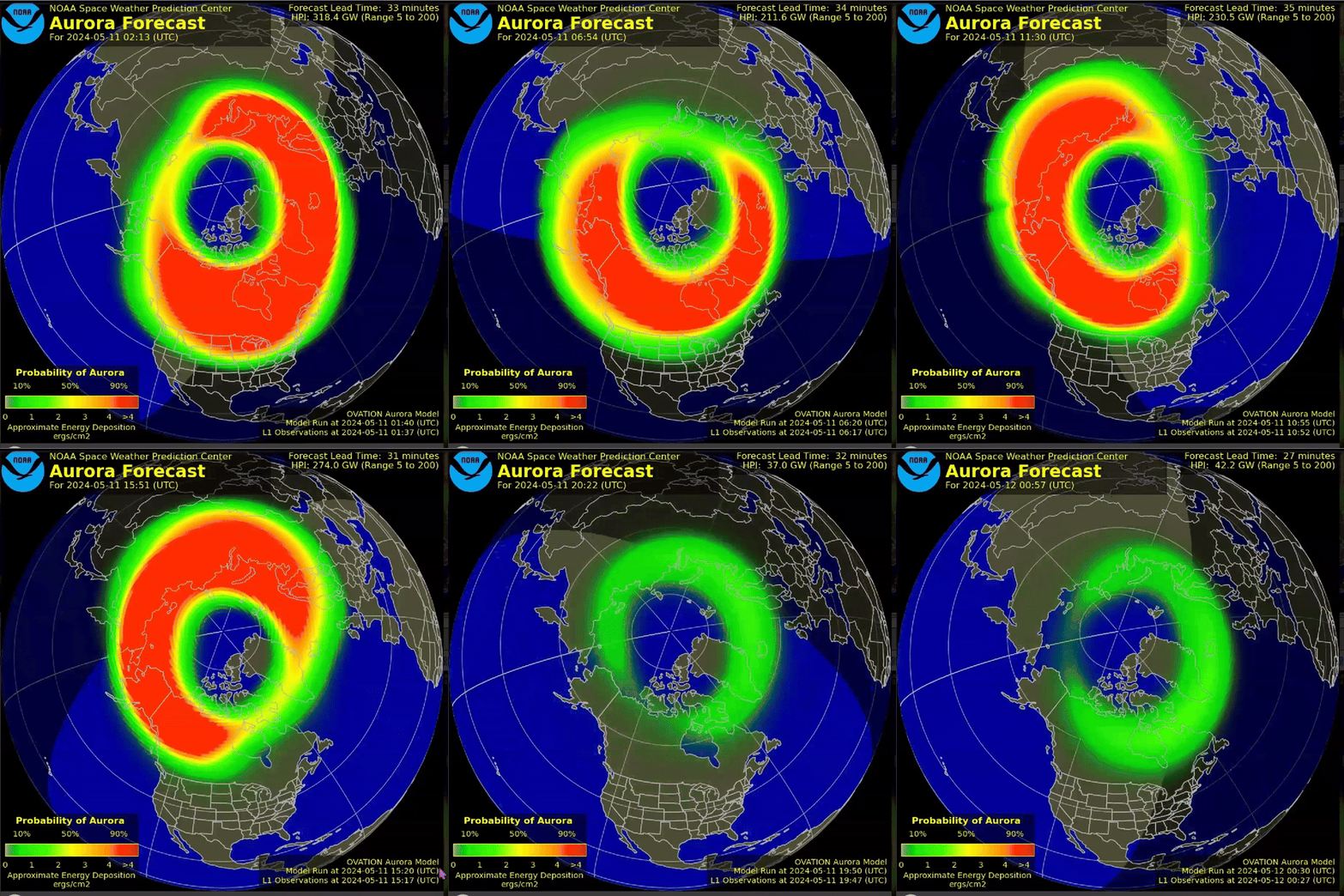
Is an Aurora Borealis Brighter Anywhere?
If you happen to find yourself in close proximity to either the North or South Pole, you might have the opportunity to witness a truly extraordinary spectacle. On numerous occasions, the sky becomes adorned with stunning displays of light, commonly referred to as auroras. In the vicinity of the North Pole, this phenomenon is known as the Aurora Borealis or “northern lights”. Conversely, if you happen to be near the South Pole, you would be treated to the Aurora Australis or the “southern lights”. Despite the fact that auroras are most visible during the night, their origin can be attributed to the Sun. In addition to heat and light, the Sun emits various forms of energy and tiny particles towards us. Fortunately, the Earth’s magnetic field acts as a protective shield, preventing the majority of these energy and particles from affecting us, often without our awareness.
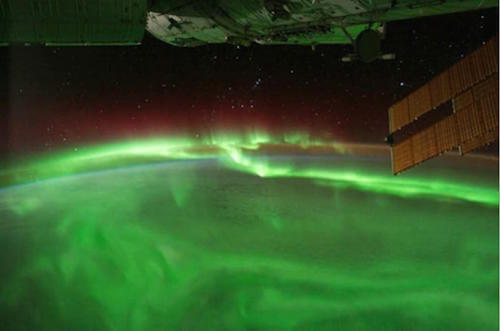
Image courtesy of NASA Space Place – NASA Science for Kids
What is an Aurora Borealis?
The Aurora Borealis shows on Earth as an eerie looking patch of cloud-like green lighting in the form of brush-like strokes, gracefully spanning from the left to the right side. The shades of green and yellow exhibit a range of intensities, ranging from gentle, subtle pastels to richer greens and violets. The brilliance of the aurora is most pronounced at the lower part of the streak, gradually diminishing as the lights ascend.
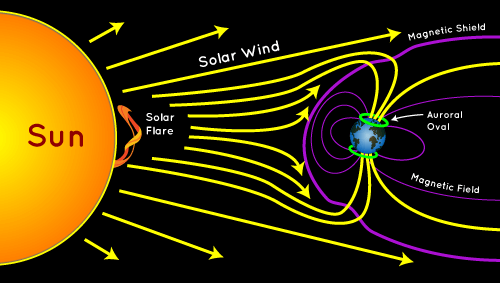
Image courtesy of NASA Space Place – NASA Science for Kids
An example of a solar storm approaching Earth involves the transmission of energy and tiny particles along the magnetic field lines towards the Earth’s atmosphere, specifically at the north and south poles.
What is an Aurora Borealis?
The Sun does not emit a consistent amount of energy at all times. It continuously releases a solar wind and occasionally experiences solar storms. In the case of a specific type of solar storm known as a coronal mass ejection, the Sun expels a massive bubble of charged gas that can rapidly traverse through space.
Do Auroras Happen on Other Planets?
They sure do! Auroras are not just something that happen on Earth. If a planet has an atmosphere and magnetic field, they probably have auroras. We’ve seen amazing auroras on Jupiter and Saturn.
Aurora Borealis – May 11th, 2024
More on Versatileer:
![Forever Jamison by Heather Young-Nichols__BUTTON.jpg]()
Ends 04-27 – Forever Jamison by Heather Young-Nichols Book Blitz+ $25 Amazon Gift Card Giveaway
04/17/2023![FOX NFL Sunday Live Hosts Pearl Harbor Remembrance Special.jpg]()
National Pearl Harbor Remembrance Day – 2025
12/13/2025![Penance4.jpg]()
Ends 01-24 – The Penance of Valentine Cash by Rebecca Rook Book Blitz + Print Copy + Swag (Candle, P...
01/15/2024![wp-17160692532442884084095719022_.jpg]()
Featured Photo: Flower of the Day – Bachelor Button Tall Mix (Cornflowers)
05/28/2024![Plantain Wide Brim Hosta__20210717_193312.jpg]()
Featured Photo: Flower of the Day – Plantain Wide Brim Hosta
09/21/2021