

Constellations of the Month: August – Corona Australis:
We continue August with the next constellation of the month, Corona Australis, “The Southern Crown.”

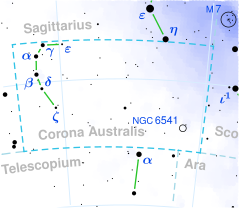
Corona Australis constellation map courtesy of Openverse
Corona Australis, “The Southern Crown” – The Corona Australis constellation is located in the southern hemisphere, and symbolizes “the southern crown.” Corona Australis is situated between the constellations Sagittarius and Scorpius. Some sources suggest that Corona Australis symbolizes the crown worn by the centaur depicted by Sagittarius; however, the constellation is not specifically associated with any particular myth. At times, it is also referred to as Corona Austrina. The Greek astronomer Ptolemy first catalogued Corona Australis in the 2nd century, alongside the constellation representing the northern crown, Corona Borealis.


Corona Australis Corona Australis Molecular Cloud courtesy of Openverse
Key points regarding Corona Australis:
- Meaning: The term “Corona Australis” translates to “The Southern Crown” in Latin. Corona Australis has no stars brighter than magnitude 3.00 or within 10 parsecs of Earth. Its brightest star is Alpha Coronae Australis, known as Meridiana, which is also the only formally named star in the constellation, approved by the International Astronomical Union. The nearest star is HD 166348, located 42.26 light years away. Two stars in Corona Australis have known planets, including HD 166724, which has a long-period planet discovered in 2012. The constellation is part of the Hercules family and contains no Messier objects, but is known for the Corona Australis Nebula, the Coronet Cluster, and the Corona Austrinids meteor shower.
- Notable stars: Alpha Coronae Australis, also called Meridiana, is a class A2V star with an apparent magnitude of 4.10 and is 130 light years away. It is the only named star in its constellation, named after Alphecca from the northern constellation Corona Borealis. Beta Coronae Australis is a K-type bright giant with an apparent magnitude of 4.117, located about 510 light years from Earth, and has an absolute magnitude of -1.8. R Coronae Australis is a variable star, approximately 26.8 light years away, and shows a mean apparent magnitude of 11.5. It is a young, pre-main sequence star that is still gathering material and is surrounded by a star-forming region, NGC 6726/27/29. RX J1856. 5-3754 is a neutron star located about 400 light years away, moving at 108 km/s. It formed from a supernova around a million years ago and was confirmed to be a neutron star with a diameter of approximately 14 kilometers. It is part of a group called the Magnificent Seven, known for emitting soft X-rays.
- Other features: Corona Australis Nebula is a bright reflection nebula located about 420 light years away, made up of several bright stars within a dark dust cloud that is a star-forming region. It includes three parts: NGC 6726, NGC 6727, and NGC 6729, discovered by Johann Friedrich Julius Schmidt in 1861. This area is known for recent low-mass star formation. NGC 6541 is a large, bright globular cluster found by Niccolò Cacciatore and James Dunlop in 1826, situated between the stars Theta Coronae Australis and Theta Scorpii. The reflection nebula NGC 6726/6727 is lit by TY Coronae Australis, a variable star. NGC 6729 is a fan-shaped reflection/emission nebula located near Zeta Sagittarii. The Coronet cluster, at the heart of Corona Australis, is one of the nearest areas with ongoing star formation.
- Mythology: Corona Australis was referred to by the Greeks as a wreath rather than a crown. Prior to Ptolemy’s classification of its stars as a distinct constellation, Corona Australis was recognized as a circlet of stars located near the forefeet of the centaur depicted by the adjacent constellation Sagittarius. This constellation is occasionally linked to the myth of Dionysus. In this narrative, Corona Australis symbolizes the crown that the god placed in the heavens after rescuing his mother Semele from Hades, the god of the underworld. However, this specific myth is also sometimes connected to the Northern Crown, known as Corona Borealis. Initially, Ptolemy designated 13 stars to the constellation Corona Australis, but one of these stars was subsequently relocated to the constellation Telescopium, where it was renamed Alpha Telescopii.
- Visibility: Corona Australis is the 80th largest constellation, covering 128 square degrees. Situated in the third quadrant of the southern hemisphere (SQ3), it can be observed at latitudes ranging from +40° to -90°. The constellations that border it include Ara, Sagittarius, Scorpius, and Telescopium. The name of the constellation, Corona Australis, is pronounced /koʊˈroʊnə ɔːˈstrælɪs/. In English, it is referred to as the Southern Crown. The genitive form of Corona Australis, which is utilized in the naming of stars, is Coronae Australis (pronunciation: /koʊˈroʊniː ɔːˈstrælɪs/). The three-letter abbreviation, which was established by the International Astronomical Union (IAU) in 1922, is CrA.
⁺‧₊☽◯☾₊‧⁺⋆⁺‧₊☽◯☾₊‧⁺⋆⁺‧₊☽◯☾₊‧⁺⋆⁺‧₊☽◯☾₊‧⁺⋆⁺‧₊☽◯☾₊‧⁺⋆⁺‧₊☽◯☾₊‧⁺⋆
Constellations:
| Constellations by Month | ||
| JANUARY [8] | FEBRUARY [7] | MARCH [7] |
| Taurus | Camelopardalis | Ursa Major |
| Orion | Auriga | Cancer |
| Lepus | Gemini | Canis Minor |
| Caelum | Monoceros | Pyxis |
| Reticulum | Canis Major | Vela |
| Dorado | Columba | Carina |
| Pictor | Puppis | Volans |
| Mensa | ||
| APRIL [8] | MAY [7] | JUNE [6] |
| Ursa Major | Canes Venatici | Ursa Minor |
| Leo Minor | Coma Berenices | Boötes |
| Leo | Virgo | Libra |
| Sextans | Corvus | Lupus |
| Crater | Centaurus | Circinus |
| Hydra | Crux | Apus |
| Antlia | Musca | |
| Chamaeleon | ||
| JULY [9] | AUGUST [9] | SEPTEMBER [6] |
| Draco | Lyra | Cygnus |
| Corona Borealis | Vulpecula | Delphinus |
| Hercules | Sagitta | Equuleus |
| Serpens | Aquila | Capricornus |
| Ophiuchus | Scutum | Microscopium |
| Scorpius | Sagittarius | Indus |
| Norma | Corona Australis | |
| Ara | Telescopium | |
| Triangulum Australe | Pavo | |
| OCTOBER [7] | NOVEMBER [8] | DECEMBER [6] |
| Cepheus | Cassiopeia | Perseus |
| Lacerta | Andromeda | Triangulum |
| Pegasus | Pisces | Aries |
| Aquarius | Cetus | Eridanus |
| Piscis Austrinus | Sculptor | Fornax |
| Grus | Phoenix | Horologium |
| Octans | Tucana | |
| Hydrus | ||

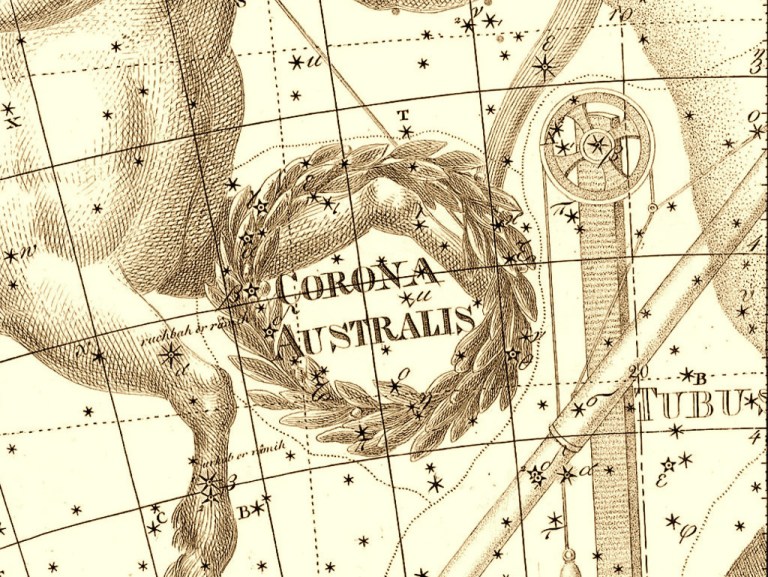
Corona Australis courtesy of Openverse
Constellations of the Month:
August – Corona Australis
Material may be shared for personal and educational use, Share with family and friends. The material cannot be used in an educational setting whereby a “book fee” is charged in or above tuition costs, and the material here is being used without paying a licensing fee.. AI must file an application for use of such material.
| You May Also Like. . . | |
 NASA 1997 Liftoff Special |
 NASA Mission Patch Party |

