

Constellations of the Month: August – Scutum:
We continue August with the next constellation of the month, Scutum, “The Shield.”


Scutum constellation map courtesy of Openverse
Scutum, “The Shield” – The Scutum constellation is located in the southern hemisphere, and symbolizes “the shield.” Scutum ranks as the fifth smallest constellation in the celestial sphere. This constellation was first introduced by the Polish astronomer Johannes Hevelius during the 17th century. Hevelius designated it as Scutum Sobiescianum, or Shield of Sobieski, in tribute to the Polish King Jan III Sobieski, who triumphed in the Battle of Vienna in 1683. A year later, Hevelius established the constellation to honor this significant event, and the name was later shortened to Scutum. Among the notable deep sky objects found in Scutum are Messier 11, known as the Wild Duck Cluster, and the open cluster Messier 26. Additionally, the constellation features the well-known variable star Delta Scuti, as well as the red supergiants Stephenson 2-18 and UY Scuti, both of which have been recognized as the largest known stars.

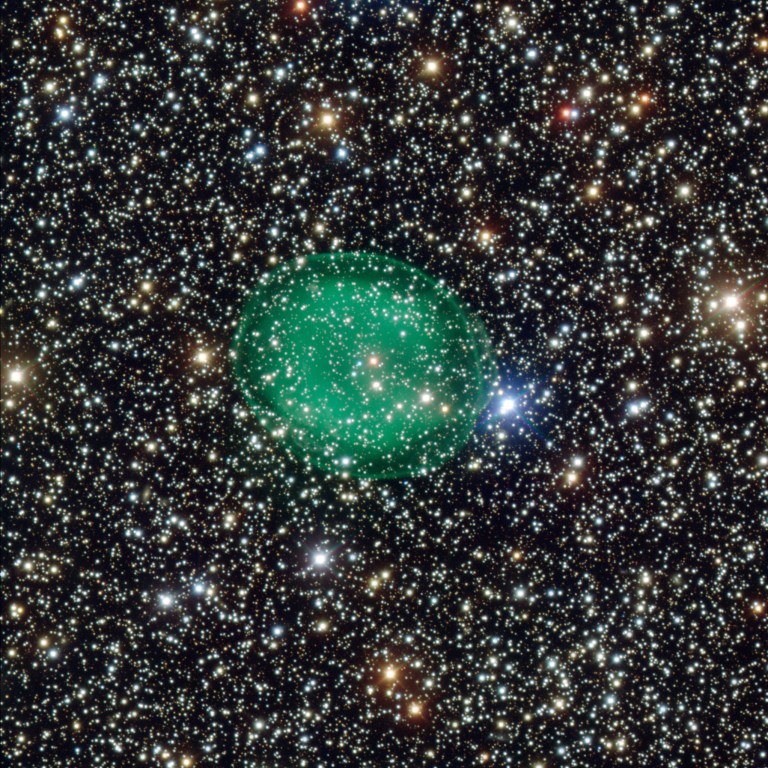
File:ESO’s VLT images the planetary nebula IC 1295 courtesy of Openverse
Key points regarding Scutum:
- Meaning: The term “Scutum” translates to “The Shield” in Latin. Scutum does not contain any named stars. Scutum comprises two Messier objects – Messier 11 (M11, NGC 6705, known as the Wild Duck Cluster) and Messier 26 (M26, NGC 6694). Additionally, there is one meteor shower linked to the constellation, referred to as the June Scutids.
- Notable stars: Alpha Scuti is the brightest star in the constellation Scutum, classified as an orange giant with an apparent magnitude of 3.85. It is about 174 light years from Earth and varies in brightness. Beta Scuti follows as the second brightest, a yellow giant with an apparent magnitude of 4.22, located approximately 690 light years away. Zeta Scuti is the third brightest, classified as a yellow giant, about 207 light years distant, and is an astrometric binary system. Gamma Scuti is a white subgiant star that is the fourth brightest, situated around 291 light years from Earth. Delta Scuti is a well-known variable star, known for its brightness fluctuations, located approximately 202 light years away. Eta Scuti is an orange giant around 207 light years distant. Epsilon Scuti is a multiple star system, while R Scuti is a yellow supergiant and the brightest RV Tauri variable. PSR B1829-10 is a pulsar, 30,000 light years away.
- Other features: The Wild Duck Cluster, discovered by Gottfried Kirch in 1681, is an open cluster with about 2,900 stars, located 6,200 light years from the Sun. Messier 26, discovered by Charles Messier in 1764, is another open cluster about 5,000 light years away, containing stars with a magnitude of 11.9. NGC 6712 is a globular cluster at 22,500 light years away, discovered by Le Gentil in 1749. IC 1295 is a planetary nebula about 3,300 light years distant, featuring a shedding white dwarf. RSGC1 and Alicante 8 are massive young open clusters, unseen in visible light, with ages around 10-20 million years. Stephenson 2, containing one of the largest known stars, and Mercer 3, a globular cluster embedded in the Milky Way, are also notable.
- Mythology: Scutum is a constellation that is unique because it is named after a historical figure, the Polish King John III Sobieski, rather than associated with myths. The Polish astronomer Johannes Hevelius created it in 1684 to honor Sobieski’s victory in the Battle of Vienna in 1683 and his support in rebuilding Hevelius’s observatory after a fire. Scutum was first mentioned in the journal Acta Eruditorum in August 1684. The name was later shortened to Scutum, which means “shield. “
- Visibility: Scutum is the 84th largest constellation, covering 109 square degrees, and is located in the southern hemisphere, visible between +80° and -90° latitudes. It neighbors Aquila, Sagittarius, and Serpens Cauda. The name Scutum, pronounced /ˈskjuːtəm/, means “Shield” in English, and its genitive form is Scuti. The International Astronomical Union (IAU) designated the abbreviation Sct in 1922. Scutum has no stars brighter than magnitude 3.00, with Alpha Scuti as the brightest at 3.85. The nearest star is LHS 3398, 41.54 light years away. Only one star, COROT-17, has a confirmed exoplanet. Scutum is part of the Hercules constellation family.
⁺‧₊☽◯☾₊‧⁺⋆⁺‧₊☽◯☾₊‧⁺⋆⁺‧₊☽◯☾₊‧⁺⋆⁺‧₊☽◯☾₊‧⁺⋆⁺‧₊☽◯☾₊‧⁺⋆⁺‧₊☽◯☾₊‧⁺⋆
Constellations:
| Constellations by Month | ||
| JANUARY [8] | FEBRUARY [7] | MARCH [7] |
| Taurus | Camelopardalis | Ursa Major |
| Orion | Auriga | Cancer |
| Lepus | Gemini | Canis Minor |
| Caelum | Monoceros | Pyxis |
| Reticulum | Canis Major | Vela |
| Dorado | Columba | Carina |
| Pictor | Puppis | Volans |
| Mensa | ||
| APRIL [8] | MAY [7] | JUNE [6] |
| Ursa Major | Canes Venatici | Ursa Minor |
| Leo Minor | Coma Berenices | Boötes |
| Leo | Virgo | Libra |
| Sextans | Corvus | Lupus |
| Crater | Centaurus | Circinus |
| Hydra | Crux | Apus |
| Antlia | Musca | |
| Chamaeleon | ||
| JULY [9] | AUGUST [9] | SEPTEMBER [6] |
| Draco | Lyra | Cygnus |
| Corona Borealis | Vulpecula | Delphinus |
| Hercules | Sagitta | Equuleus |
| Serpens | Aquila | Capricornus |
| Ophiuchus | Scutum | Microscopium |
| Scorpius | Sagittarius | Indus |
| Norma | Corona Australis | |
| Ara | Telescopium | |
| Triangulum Australe | Pavo | |
| OCTOBER [7] | NOVEMBER [8] | DECEMBER [6] |
| Cepheus | Cassiopeia | Perseus |
| Lacerta | Andromeda | Triangulum |
| Pegasus | Pisces | Aries |
| Aquarius | Cetus | Eridanus |
| Piscis Austrinus | Sculptor | Fornax |
| Grus | Phoenix | Horologium |
| Octans | Tucana | |
| Hydrus | ||

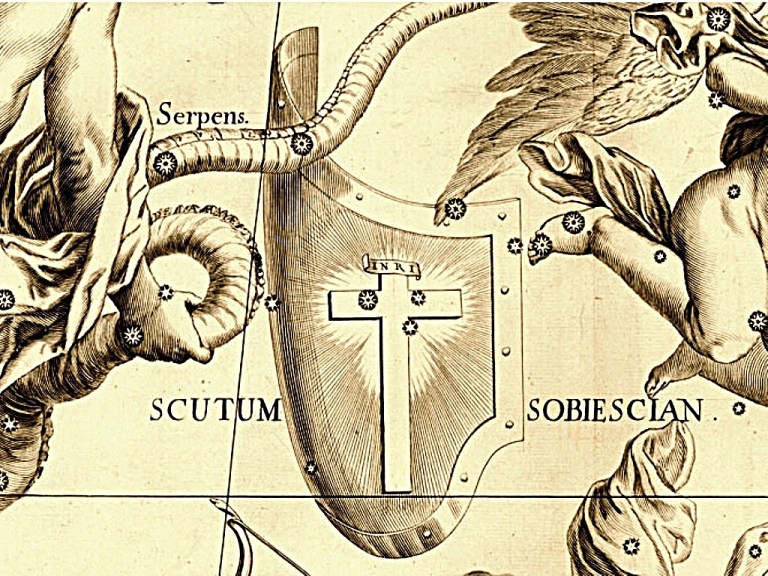
Photo by Europeana on Unsplash
Constellations of the Month:
August – Scutum
Material may be shared for personal and educational use, Share with family and friends. The material cannot be used in an educational setting whereby a “book fee” is charged in or above tuition costs, and the material here is being used without paying a licensing fee.. AI must file an application for use of such material.
| You May Also Like. . . | |
 NASA 1997 Liftoff Special |
 NASA Mission Patch Party |

