

Constellations of the Month: March – Pyxis:
We continue March with the next constellation of the month, Pyxis, “Mariner’s Compass.”


Pyxis constellation map courtesy of Openverse
Pyxis, “Mariner’s Compass” – Pyxis is a constellation in the southern sky that symbolizes a mariner’s compass. It was created by the French astronomer Nicolas Louis de Lacaille in the 18th century, who originally named it Pyxis Nautica, later shortened to Pyxis. Located near the old constellation Argo Navis, Pyxis represents the ship’s compass but is not a Greek constellation. It contains notable deep sky objects like the planetary nebula NGC 2818, the open cluster NGC 2627, and the barred spiral galaxy NGC 2613.

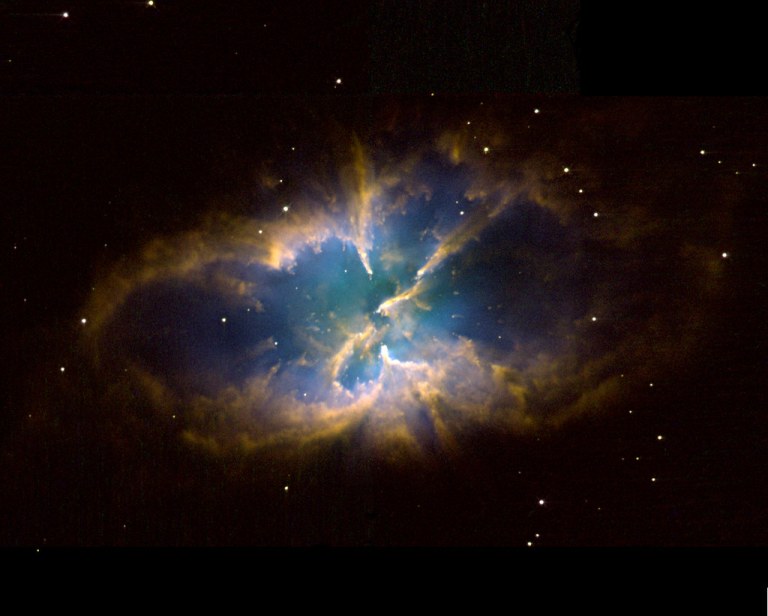
NGC 2818 courtesy of Openverse
Key points regarding Pyxis:
- Meaning: The term “Pyxis” translates to “Mariner’s Compass” in Latin.
- Notable stars: Alpha Pyxidis is a giant blue star with a brightness of 3.67, located 880 light years away. It varies in brightness due to pulsations and has over 10 solar masses, ending its life as a supernova. Beta Pyxidis is a binary star, 420 light years away, with a brightness of 3.954, classified as a bright giant or supergiant. Gamma Pyxidis is an orange giant, third brightest in Pyxis, with a brightness of 4. 026, located 209 light years away. T Pyxidis, a binary system with a Sun-like star and a white dwarf, can brighten to 6.4 during eruptions and is about 10,388 light years away. Kappa, Theta, Zeta, and Delta Pyxidis are also noted for their brightness and distance from Earth.
- Other features: NGC 2818 is a planetary nebula in Pyxis, formed when a star shed its outer layers, creating glowing gases. The central star’s core remains as a white dwarf. The nebula is 3.25 light years in radius and about 10,400 light years from the solar system. NGC 2627 is an open star cluster in Pyxis with about 40 stars, magnitudes 11 to 13, and a visual magnitude of 8. 4. It is roughly 8000 light years away, located southwest of Zeta Pyxidis. NGC 2613 is a barred spiral galaxy, viewed nearly edge-on, likely similar to the Milky Way, with an apparent magnitude of 10. 6 and around 60 million light years distant.
- Mythology: In mythology, Pyxis was created by French astronomer Nicolas Louis de Lacaille in 1751-52 during his study of the southern skies. He named it la Boussole and later changed its name to Pixis Nautica, which was shortened to Pyxis in 1763. Pyxis symbolizes the magnetic compass used by navigators and should not be mixed up with Circinus, which represents a draftsman’s compass. Pyxis is near the three constellations from Argo Navis, which Lacaille divided into Carina, Puppis, and Vela. John Herschel suggested renaming Pyxis to Malus in 1844, but the name Pyxis was ultimately accepted by the IAU as one of the 88 modern constellations.
- Visibility: Pyxis is the 65th largest constellation, covering 221 square degrees, located in the southern hemisphere at latitudes from +50° to -90°. Nearby constellations include Antlia, Hydra, Puppis, and Vela. Pyxis is pronounced /ˈpɪksɪs/ and known as the Compass. Its genitive form is Pyxidis. The International Astronomical Union’s abbreviation for Pyxis is Pyx. The constellation has three stars with known planets and its brightest star is Alpha Pyxidis, with a magnitude of 3.68. Pyxis has no named stars or associated meteor showers.
⁺‧₊☽◯☾₊‧⁺⋆⁺‧₊☽◯☾₊‧⁺⋆⁺‧₊☽◯☾₊‧⁺⋆⁺‧₊☽◯☾₊‧⁺⋆⁺‧₊☽◯☾₊‧⁺⋆⁺‧₊☽◯☾₊‧⁺⋆
Constellations:
| Constellations by Month | ||
| JANUARY [8] | FEBRUARY [7] | MARCH [7] |
| Taurus | Camelopardalis | Lynx |
| Orion | Auriga | Cancer |
| Lepus | Gemini | Canis Minor |
| Caelum | Monoceros | Pyxis |
| Reticulum | Canis Major | Vela |
| Dorado | Columba | Carina |
| Pictor | Puppis | Volans |
| Mensa | ||
| APRIL [8] | MAY [7] | JUNE [6] |
| Ursa Major | Canes Venatici | Ursa Minor |
| Leo Minor | Coma Berenices | Boötes |
| Leo | Virgo | Libra |
| Sextans | Corvus | Lupus |
| Crater | Centaurus | Circinus |
| Hydra | Crux | Apus |
| Antlia | Musca | |
| Chamaeleon | ||
| JULY [9] | AUGUST [9] | SEPTEMBER [6] |
| Draco | Lyra | Cygnus |
| Corona Borealis | Vulpecula | Delphinus |
| Hercules | Sagitta | Equuleus |
| Serpens | Aquila | Capricornus |
| Ophiuchus | Scutum | Microscopium |
| Scorpius | Sagittarius | Indus |
| Norma | Corona Australis | |
| Ara | Telescopium | |
| Triangulum Australe | Pavo | |
| OCTOBER [7] | NOVEMBER [8] | DECEMBER [6] |
| Cepheus | Cassiopeia | Perseus |
| Lacerta | Andromeda | Triangulum |
| Pegasus | Pisces | Aries |
| Aquarius | Cetus | Eridanus |
| Piscis Austrinus | Sculptor | Fornax |
| Grus | Phoenix | Horologium |
| Octans | Tucana | |
| Hydrus | ||


pyxis courtesy of Openverse
Constellations of the Month:
March – Pyxis
Material may be shared for personal and educational use, Share with family and friends. The material cannot be used in an educational setting whereby a “book fee” is charged in or above tuition costs, and the material here is being used without paying a licensing fee.. AI must file an application for use of such material.
| You May Also Like. . . | |
 NASA 1997 Liftoff Special |
 NASA Mission Patch Party |

