

Constellations of the Month: May – Canes Venatici:
We start May with the first constellation of the month, Canes Venatici, “Hunting Dogs.”

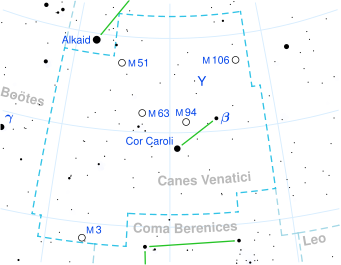
Canes Venatici constellation map courtesy of Openverse
Canes Venatici, “Hunting Dogs” – The Canes Venatici constellation is located in the northern hemisphere, and symbolizes “the hunting dogs.” Canes Venatici represents the hunting dogs of Boötes, the Herdsman, with the dogs named Asterion and Chara. Ptolemy included its stars in Ursa Major, but the constellation was formally created in 1687 by Johannes Hevelius. Canes Venatici features notable stars like Cor Caroli and La Superba, along with deep sky objects like the Whirlpool Galaxy and the Cat’s Eye Galaxy.


Photo by NASA Hubble Space Telescope courtesy of Openverse
Key points regarding Canes Venatici:
- Meaning: The term “Canes Venatici” translates to “Hunting Dogs” in Latin. Canes Venatici has five Messier objects: M3, the Whirlpool Galaxy, the Sunflower Galaxy, M94, and M106. It hosts a meteor shower called Canes Venaticids in January. The constellation has five named stars: Chara, Cor Caroli, Komondor, La Superba, and Tuiren. It is part of the Ursa Major family of constellations.
- Notable stars: Cor Caroli is the brightest star in its constellation, with a brightness that varies from 2. 84 to 2. 98 and is about 110 light years away. Its name means “Charles’ heart,” named by Sir Charles Scarborough in honor of Charles I. Cor Caroli is a binary star system, consisting of Alpha-2 CVn, a chemically unique star with a strong magnetic field, and Alpha-1 CVn, an F-type star with an apparent magnitude of 5.60. Chara, Beta CVn, is the second brightest star in Canes Venatici, similar to the Sun and named for the word “joy. ” La Superba is a red star losing mass and surrounded by ejected material, varying in brightness over 160 days. AM CVn is a cataclysmic variable star, while RS Canum Venaticorum is known for brightness variations linked to its orbital period.
- Other features: Messier 3 is a globular cluster located about 33,900 light years from Earth, containing around 500,000 stars. Discovered by William Herschel in 1784, it is one of the largest and brightest clusters, with an estimated age of 8 billion years and an apparent magnitude of 6.2. The Whirlpool Galaxy, also known as Messier 51a, is 31 million light years away and interacts with the dwarf galaxy NGC 5195, which has a distorted shape due to their connection. Discovered by Charles Messier in 1774, it has an apparent magnitude of 8.4 and a bright disk with a radius of 38,000 light years. Notable other galaxies include the Sunflower Galaxy, Messier 94, Messier 106, and several members of the M51 Group, each with distinct features and distances. NGC 5005 is a spiral galaxy located 65 million light years away, featuring a bright nucleus, while NGC 4151 and NGC 4618 are classified as Seyfert and distorted dwarf galaxies, respectively. NGC 4625 also shows asymmetry. NGC 5371 is a face-on spiral galaxy, NGC 4656/NGC 4657 is a disrupted barred spiral, and NGC 4183 and NGC 4214 are spiral and dwarf barred irregular galaxies, respectively. The Cocoon Galaxy and IC 883 are other notable deep sky objects in the region.
- Mythology: In the Middle Ages, Canes Venatici was linked to two dogs held by Boötes due to a mistake in translating Ptolemy’s Almagest from Greek to Arabic. The translation error involved interpreting the Greek word for “club” as a phrase for “spearshaft with a hook,” leading to confusion with the Arabic word for “dogs. ” Peter Apian depicted Boötes with two dogs in 1533, and in the 17th century, Hevelius named the dogs Asterion and Chara, with Chara eventually referring to the star Beta CVn.
- Visibility: Canes Venatici is the 38th largest constellation, covering 465 square degrees. It is in the northern hemisphere and visible between latitudes +90° and -40°. Neighboring constellations are Boötes, Coma Berenices, and Ursa Major. Its name means Hunting Dogs in English. The brightest star is Cor Caroli, and the nearest star is DG Canum Venaticorum at 25.89 light years from Earth. It has four stars with known planets.
⁺‧₊☽◯☾₊‧⁺⋆⁺‧₊☽◯☾₊‧⁺⋆⁺‧₊☽◯☾₊‧⁺⋆⁺‧₊☽◯☾₊‧⁺⋆⁺‧₊☽◯☾₊‧⁺⋆⁺‧₊☽◯☾₊‧⁺⋆
Constellations:
| Constellations by Month | ||
| JANUARY [8] | FEBRUARY [7] | MARCH [7] |
| Taurus | Camelopardalis | Ursa Major |
| Orion | Auriga | Cancer |
| Lepus | Gemini | Canis Minor |
| Caelum | Monoceros | Pyxis |
| Reticulum | Canis Major | Vela |
| Dorado | Columba | Carina |
| Pictor | Puppis | Volans |
| Mensa | ||
| APRIL [8] | MAY [7] | JUNE [6] |
| Ursa Major | Canes Venatici | Ursa Minor |
| Leo Minor | Coma Berenices | Boötes |
| Leo | Virgo | Libra |
| Sextans | Corvus | Lupus |
| Crater | Centaurus | Circinus |
| Hydra | Crux | Apus |
| Antlia | Musca | |
| Chamaeleon | ||
| JULY [9] | AUGUST [9] | SEPTEMBER [6] |
| Draco | Lyra | Cygnus |
| Corona Borealis | Vulpecula | Delphinus |
| Hercules | Sagitta | Equuleus |
| Serpens | Aquila | Capricornus |
| Ophiuchus | Scutum | Microscopium |
| Scorpius | Sagittarius | Indus |
| Norma | Corona Australis | |
| Ara | Telescopium | |
| Triangulum Australe | Pavo | |
| OCTOBER [7] | NOVEMBER [8] | DECEMBER [6] |
| Cepheus | Cassiopeia | Perseus |
| Lacerta | Andromeda | Triangulum |
| Pegasus | Pisces | Aries |
| Aquarius | Cetus | Eridanus |
| Piscis Austrinus | Sculptor | Fornax |
| Grus | Phoenix | Horologium |
| Octans | Tucana | |
| Hydrus | ||

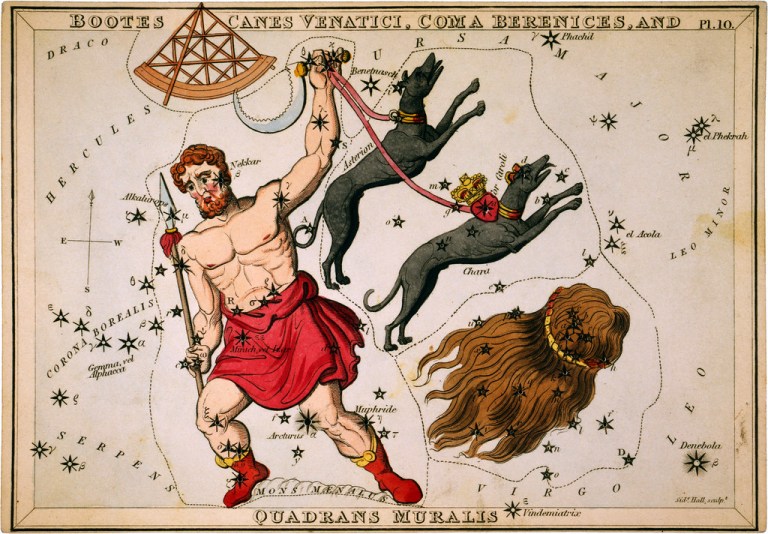
From Urania’s Mirror: Boötes, Canes Venatici, Coma Berenices, and Quadrans Muralis, 1825 courtesy of Openverse
Constellations of the Month:
May – Canes Venatici
Material may be shared for personal and educational use, Share with family and friends. The material cannot be used in an educational setting whereby a “book fee” is charged in or above tuition costs, and the material here is being used without paying a licensing fee.. AI must file an application for use of such material.
| You May Also Like. . . | |
 NASA 1997 Liftoff Special |
 NASA Mission Patch Party |

